
Overview
Objectives
- Recall the Jamaican influences on hip-hop
- Recall the role of the DJ and the MC in early hip-hop
- Recall some of the earliest commercial hip-hop and hip-hop-influenced recordings
- Examine the role rock music played in the success of groups such as Run-DMC and the Beastie Boys
The Roots of Hip-Hop
Hip-hop originated in New York in the early 1970s in neighborhoods that were primarily African American, Afro-Caribbean, and Latino. Hip-hop is a combination of different artistic expressions, including graffiti, breakdancing (also called b-boying or b-girling), DJing, and rapping.
As we saw in the lesson on disco, the DJ was becoming an increasingly important artistic figure in music of the late 1970s. A DJ who would artfully combine different recordings and keep people dancing all night was valued as much as a four-piece band who played live.
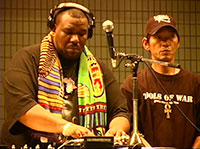
Many of the most important DJs in the early days of hip-hop were of Jamaican or Caribbean descent, and they drew from these musical traditions. One Jamaican tradition borrowed by early hip-hop artists was the mobile DJ unit, in which the DJ would bring their records and equipment to a specific location or event. In many cases, two DJs would be booked for the same event, and they would compete for the audience’s attention and approval. Another Jamaican tradition is the act of speaking over the recorded music. Early DJs spoke to the audiences in what were called toastsJamaican tradition where DJs speak over the recorded music, often engaging in call and response chants with the dancers or encouraging audience participation, praising the dancers, encouraging audience participation, and announcing upcoming events. The DJ would engage in call and response chants with the dancers, or he would command them to "throw your hands in the air and wave them like you just don’t care." Often, DJs would drop the lyrics from popular songs and create an instrumental version of the song over which he would toast at social events.
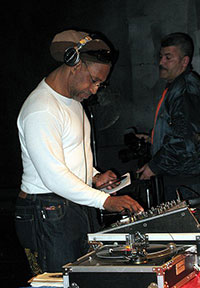
DJs were valued for their complex technical skills and for their abilities to transform existing recordings into new and exciting sounds. DJ Kool Herc immigrated to the Bronx from Jamaica as a teenager, and he brought with him his knowledge of mobile DJ units and toasting. By 1973, he was regularly hosting house parties and providing music for block parties. Using two turntables, Kool Herc would place identical copies of the same record on each turntable. He would then isolate the most exciting section of the record and play it over and over, much to the delight of dancers. In many cases, Kool Herc would extract and repeat the drum break from a James Brown or Sly and the Family Stone funk record. This process of extracting and repeating the drum break end-to-end is called looping process of extracting and repeating a drum break sample end-to-end .
The dancing performed during these extended breaks came to be called breakdancing. Another important figure in early hip-hop DJing was Afrika Bambaataa. Bambaataa, whose parents were West Indian, was known for mixing incongruous sounds and recordings together. It was not uncommon to hear Bambaataa play classical music, the latest James Brown record, a cartoon show theme song, and rock music all in rapid succession. Dancers and listeners loved Bambaataa’s eclectic mixes. Bambaataa created the Zulu Nation in 1973, an organization that promoted peaceful expression through hip-hop music and dance. Battles took place on the dance floor or on the turntables instead of with violence.
Kool Herc and Afrika Bambaataa were notable because they were able to mix and combine records in unexpected ways to delight their audiences. One of the first DJs to manipulate the record itself was Grandmaster Flash. Grandmaster Flash perfected the practice of scratchingmoving the record back and forth on the turntable to create a distorted sound, that is, moving the record back and form on the turntable to create a distorted sound. He also was able to isolate very small segments of music from existing recordings and add them to an existing beat. Grandmaster Flash formed an ensemble called the Furious Five in the late 1970s. Recordings such as "The Adventures of Grandmaster Flash on the Wheels of Steel ♫" (1981) show Grandmaster Flash’s turntable skills; he combines songs by Blondie, Queen, and the funk and disco band Chic with record scratching to create a new sound. This track was created entirely with existing recorded music, and the only lyrics audible come from the recordings.
As DJs’ techniques became increasingly complex, it was difficult for them to play records and toast at the same time. Many DJs hired another person or a crew of people to speak for them, and this speaker was called an MC the MC, or master of ceremonies, would speak for a DJ while he would play records, or master of ceremonies. Kool Herc had assistants called the Herculoids, and Grandmaster Flash had the Furious Five. The rhythmic style of speech delivered by the MC was known as rapping the rhythmic style of speech delivered by the MC, a term that had originally referred to the act of seducing a woman with words. MCs began to battle just as DJs and breakdancers did, and the musical competitions in early hip-hop offered young musicians and dancers the opportunity to confront each other in a nonviolent manner.



