
Overview
Objectives
- Identify several major artists and movements from the 1980s that drew heavily on earlier forms and styles of rock music
- Examine how each artist incorporated earlier styles of music into their new albums and singles
- Recall the significance of MTV in the promotion of musicians such as the Replacements and Peter Gabriel
The Everyman
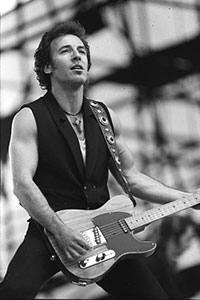
Bruce Springsteen drew heavily upon a number of older rock traditions, including 1950s rock and roll, Phil Spector’s wall of sound, the blues, and Bob Dylan’s folk music. Springsteen was from New Jersey, and he often sang with pride about his experiences and perspectives. Springsteen was backed by the E Street Band, and this group included instruments that were unusual (if not anachronistic) in rock music of the period, including violin, trombones, saxophones, and trumpets. In his music, Springsteen saw himself as the voice of the average American, a person who tries to live out the American dream in the face of heartbreak, joblessness, aging, and disappointment.
Springsteen’s third album, Born to Run (1975), had a thick, symphonic sound strongly reminiscent of Spector’s wall of sound from the 1960s. Springsteen wrote the songs on the piano, and then he described to the members of the band and the producers how he wanted the remaining instruments to sound. The album’s title single "Born to Run ♫" involved dozens of musicians recording in a style and technique very similar to that of Spector. According to Springsteen, he wanted the song to sound like "Roy Orbison singing Bob Dylan, produced by Phil Spector." Other songs on Born to Run evoke other earlier musical styles; for example, "Cover Me ♫" is based on the twelve-bar blues, a form that rock musicians had largely been ignoring since the days of the British blues revival scene.
His best-selling album was 1984’s Born in the U.S.A., which featured singles including "Glory Days ♫" and "Born in the U.S.A. ♫" Many of Springsteen’s songs indirectly criticized the government and other institutions that seemed to be at odds with the goals of the average American person, and he often sang about the difficulties faced by people who were simply trying to do the right thing. In "Born in the U.S.A. ♫," Springsteen sings of an average American life that is negatively affected by forces outside the individual’s control; the song was critical of the Vietnam War and the perceived mistreatment of Vietnam veterans, a perspective that aligned Springsteen with the folk musicians of the 1960s. Springsteen’s music was not necessarily patriotic, yet his concerts were crowded with people waving American flags.
"Born in the U.S.A. ♫" was even used by both the Democratic and Republican candidates during the 1984 Presidential election, although Springsteen did not endorse either candidate and instead played benefit concerts to benefit striking miners and unemployed steel workers.
Another singer who promoted the experiences and points of view of the working-class American was Indiana-born John Mellencamp. Mellencamp eschewed elaborate production techniques and unusual instruments, focusing instead on traditional rock instrumentation and straightforward forms and lyrics. Mellencamp, who recorded under the name John Cougar during the late 1970s and then changed to Mellencamp in the early 1980s, had his first major success with the 1982 album American Fool. American Fool featured singles such as "Jack and Diane ♫," which was a tale of "two American kids growing up in the Heartland." Mellencamp’s next album, Scarecrow (1985), included the single "Small Town ♫," an ode to the values and experiences learned by growing up in a small Midwestern town.

“It was a really interesting time in New York in the late 70s and early 80s, and the music scene was really, really interesting because you didn't have to be a virtuoso to make music, it was more about your desire to express things.”

“The E Street band casts a pretty wide net. Our influences go all the way back to the early primitive garage music, and also, we've had everything in the band from jazz players to Kansas City trumpet players to Nils Lofgren, one of the great rock guitarists in the world.”

"[Peter Gabriel] composed the music for Martin Scorsese's movie The Last Temptation Of Christ. The soundtrack won a Grammy for best New Age performance."
