
Overview:
Teachers should incorporate movement into their lessons to a enhance students’ musical understanding. Research indicates that students participating in large-motor movement and rhythmic training outperform students not receiving these experiences. Movement, kinesthetic and eurhythmic activities increase melodic-discrimination abilities and help to make abstract music concepts more concrete for students of all ages.
Objectives:
Students will be able to:
- Describe the process used to teach movement activities,
- Identify effective age-appropriate introductory movement activities,
- Delineate how movement activities can be used to teach music concepts,
- Describe the ways in which create expression is achievable through movement,
- Compare and contrast different types of movement activities,
- Describe the best practices for leading movement activities including action songs and formal dance,
- Demonstrate effective methods for leading movement activities,
- Identify and describe how movement activities are assessed.
How are Formal Dances Taught?
Formal dance is the purposeful, choreographed, and rehearsed movement to music. In the elementary classroom, folk dance is the most common variety of formal dance. Through folk dance, the music lesson can be expanded to include music, movement, and, if the opportunity presents itself, music of different cultures.
Formal dance requires the basic student skill of keeping time with the music. Despite the fact that many elementary students in kindergarten through second or third grade will not have the coordination required to perfect structured steps and formations, the practice of simple folk dance steps and patterns will provide students with an opportunity to develop their sense of rhythm and time.
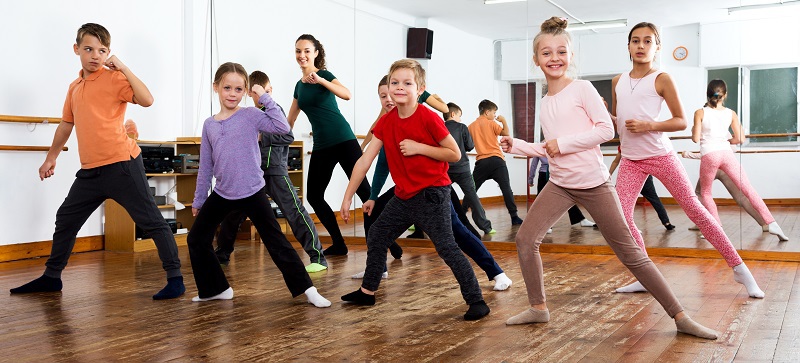
Circle and line dances, such as the “Old Brass Wagon” and the “Virginia Reel,” are the easiest dances to teach beginners, especially those dances where the student can concentrate on his own movements rather than his relationship to a partner. Phyllis Weikert, in Teaching Movement and Dance, suggests this progression for learning dance:
- Say (verbalize the movement)
- Say and do
- Whisper and do
- Do the movement
Another teaching sequence is as follows:
- Listen to the music and respond in a creative nonlocomotor way
- Chant the words to describe the dance movements in a steady rhythm
- Chant the movement words and perform the steps in a steady rhythm
- Perform the steps with the music