Overview:
Hearing is passive, but listening is active. Listening requires a higher level of engagement and results in greater knowledge if students are actively engaged in thinking about what they hear. Essentially, listening with a purpose. Students need multiple hearings in order to grasp a concept or to make an informed observation because music is “in the moment”. The practice of listening will cultivate transferable skills for how to listen critically in other situations.
Objectives:
Students will be able to:
- Describe the rationale for including listening lessons in the elementary music class,
- Summarize the ways in which aural skills and repertoire are developed through listening,
- Identify how listening lessons can reinforce music concepts,
- Illustrate the ways in which listening activities can help to formulate students’ thoughts and opinions about different music genres,
- Describe the guidelines for teaching a listening lessons,
- Design and demonstrate the sequence for teaching a listening lesson,
- Describe how listening activities can be assessed effectively, and
- Identify ways in which technology can enhance a listening lesson.
How Can Listening Encourage and Teach Creative Expression?
Listening activities provide a natural opportunity to foster student creativity. Students can also respond to listening experiences with art-related activities. The following projects help to make listening experiences more concrete:
- Draw the shape of the main theme as it occurs
- Draw simple shapes such as circles, triangles, and squares to demonstrate the form of a piece as they listen
- React to program music by creating a drawing of a scene or scenes
- Fingerpaint with poster paint or draw with fingers in shaving cream as students listen
- Choose artworks to represent specific pieces
- Draw a storyboard of the selection
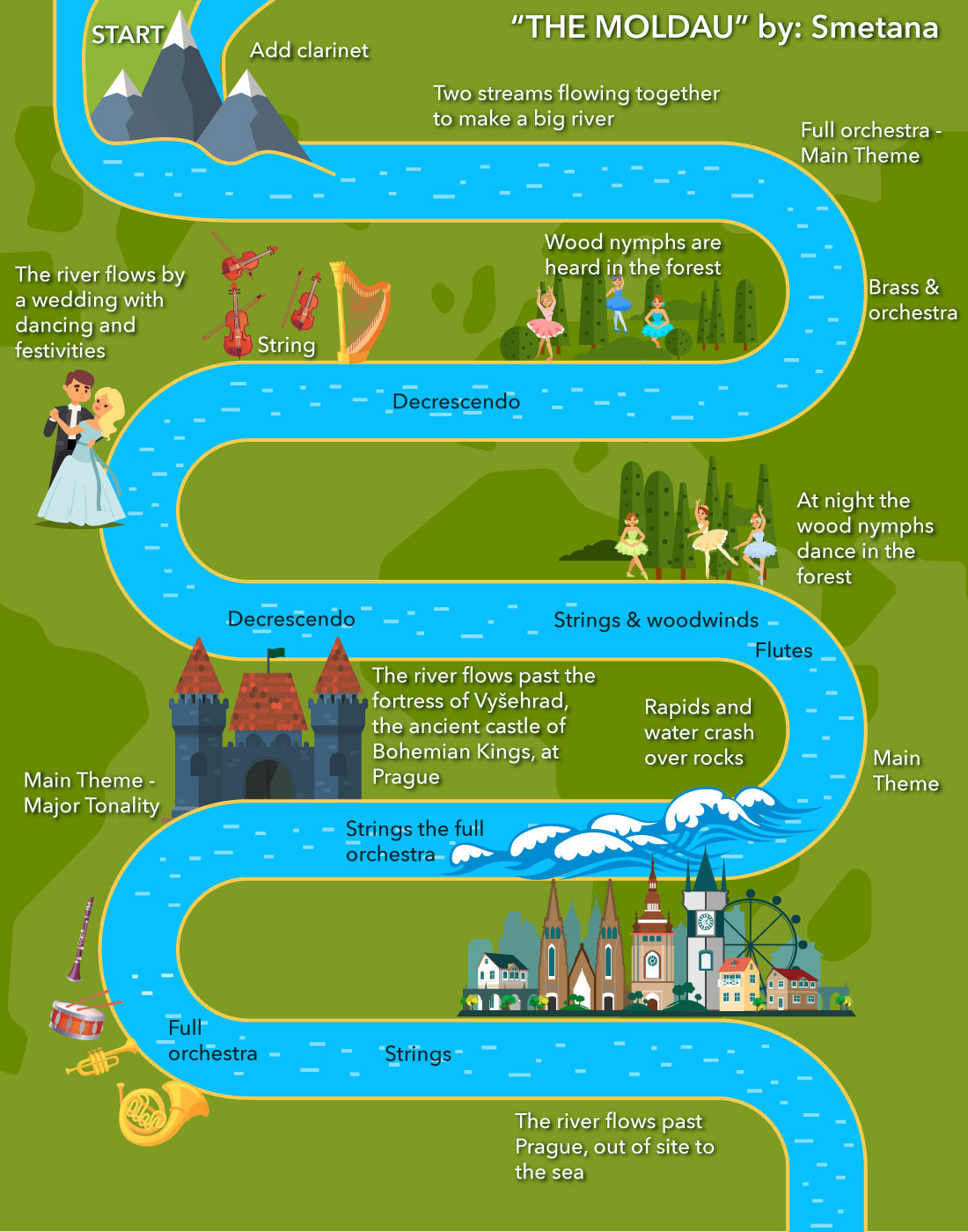
- Create a listening map or call chart
During or after a listening activity, students working in groups or individually can answer questions, move to the music, create art or literary responses, or compose new music. These activities address the different types of learning and expression—kinesthetic, visual, and verbal.
Creative kinesthetic expression might include making up movements to depict musical structure or to characterize or illustrate the music. Possible visual creative activities are inventing graphic notation, creating listening maps, associating colors with music, and painting and drawing pictures. To explore creative verbal or vocal expression, the student might be asked to discuss aspects of the music, associate words with the music, or write stories or poems that the music invokes.