
Overview:
Basic instruments (small percussion instruments or recorders) can be used by students to create preliminary compositions, set moods, a multi-sensory experience, and a hands-on means of increasing literacy skills. These fundamental tools are extensions of the student’s ability to be musically expressive. More advanced tools now available through technology are also available to expand teachers’ options in the music classroom. The best use of music technology is to enhance the curriculum rather than using it for its own sake. When used in intelligent ways, technology can be used to inspire students to want to learn, to teach students new skills, and to help them practice and improve.
Objectives:
Students will be able to:
- Summarize the rationale for incorporating instruments into elementary music lessons,
- Identify guidelines for using instruments and technology,
- Classify different types of age-appropriate instruments for classroom use,
- Describe teaching strategies for using instruments,
- Describe teaching strategies for using technology, and
- Summarize the rationale for using technology as a teaching tool.
Why are Playing Instruments Important for Students?
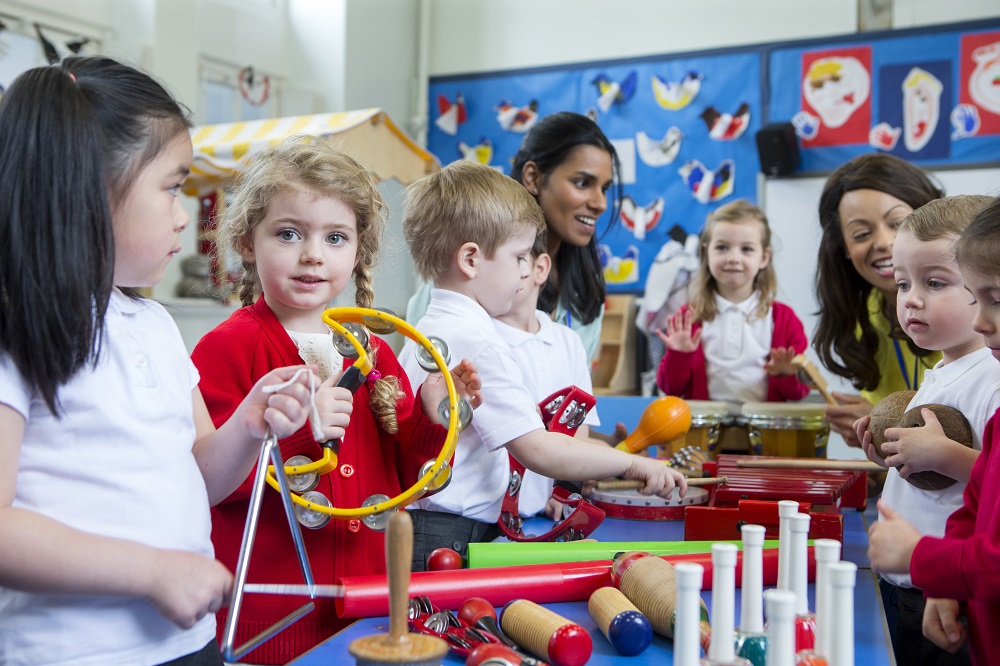
The use of instruments in the elementary music classroom provides students with a satisfying and productive means of performance. The challenges students face with learning to control their motor movements, to perform with appropriate techniques, and to produce intriguing sounds is a natural attraction. Instruments provide the mechanism and medium for musical growth whether used in solo performance, small groups, traditional ensembles, or classroom activities.
What are Effective Guidelines for Instrument Instruction?
Students must reach suitable levels of physical maturity to perform successfully on instruments using appropriate techniques. Motor development, hand-eye coordination, and breath control will often dictate when specific instruments can be introduced. Students can continue to participate in discovery and exploratory activities at young ages, but performance techniques can only be refined once students are physically ready. After playing techniques are introduced, students will need to polish their performance through practice. This table provides a brief overview matching physical development with age-appropriate instruments.
| Physical Development and Age-Appropriate Instruments | ||
|---|---|---|
| Developmental Stage | Physical Development Capabilities | Instruments and Instrument Techniques |
| Preschool | Gross motor muscle development – rock, sway, grip and grasp Generally erratic rhythm, with some periods of regularity. Age 3 to 4 – more rhythmic regularity, sense of pulse |
Rattles Bells mounted on strap Rhythm sticks Small hand drum Wood blocks Sandblocks |
| Kindergarten to Grade One | Regular pulse Alternation of hands Beginning hand-eye coordination |
Multiple drums (bongos, tom-toms, timpani) Small crash cymbals Triangle Finger cymbals Small bell set Keyboard (one hand at a time) |
| Grade Two to Grade Three | More developed hand-eye coordination | Larger drums (conga, bass, log drum) Temple blocks Medium sized Orff-Schulwerk xylophones and metallophones Recorder (top portion) Autoharp |
| Grades Four, Five, and Six | Fine motor development Refined hand-eye coordination |
Orff-Schulwerk glockenspiels and bass instruments Keyboard (both hands) Ukelele and Guitar Orchestra and Band instruments |