
Overview
Around the turn of the twentieth century, several styles and genres of music came together, and the city of New Orleans provided the catalyst for the formation of jazz. The earliest style of jazz, and one that remained popular for decades after its inception, was called Dixieland. Dixieland, like other types of jazz, allows us the chance to look at many issues of musical, racial, and commercial issues in the first quarter of the twentieth century.
Objectives
- Examine the predecessors of jazz and the diversity of styles and genres that combine in order to create the earliest jazz
- Identify the instruments, musical form, and performance style of Dixieland jazz
- Examine how the issues of race affected the earliest commercial distributions of jazz
- Identify the key figures and songs in Dixieland jazz
Recording Jazz
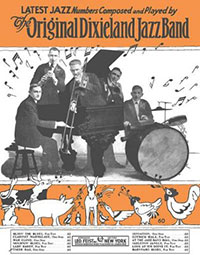
Dixieland jazz was enormously popular, and it was also one of the first genres of music to gain popularity as a recorded medium. Unfortunately, because many of the earliest Dixieland ensembles were composed of African American musicians, biases in the recording industry prevented early jazz musicians such as Armstrong, Kid Ory, and King Oliver from recording and selling their music until the 1920s. Record companies simply were not interested in recording the music of black artists or of promoting music to black audiences, and as a result, very few recordings of black artists were made until the 1920s.
The first major commercial release of jazz, "Livery Stable Blues ♫," was made in 1917 by the Original Dixieland Jazz Band, an all-white ensemble. The five members of the ensemble were from New Orleans and played in the Dixieland style, although, as we have seen, their name is certainly a misnomer, as performers such as Buddy Bolden and Kid Ory had been playing jazz well before the Original Dixieland Jazz Band. In 1916, The ODJB was invited to play for an engagement in New York, and their music became an overnight sensation. With the release of "Livery Stable Blues ♫" the following year on Victor Records, jazz began to enter the mainstream of recorded music. Although the piece followed the 12-bar blues structure common to Dixieland, it also incorporated novelty effects from the instruments, such as a mooing trombone and a neighing cornet, which delighted audiences. As we will see, African American genres of music were often first made commercially successful by white artists, and although the talent of these white artists is not in dispute, their claim to the invention of the genre certainly may be questioned.



