
Overview
While white audiences were listening to the sounds of Frank Sinatra, Patti Page, and Perry Como in the 1940s and 1950s, black listeners were consuming gospel music, doo-wop, and rhythm and blues. Although all of these genres are related to earlier styles of African American music, such as the blues, ragtime, and jazz, they all have specific features that make them unique. Technological advances in recording and broadcasting made it easier and easier to access music. As we will see, there were no color lines on the radio, which meant that white listeners began listening to rhythm and blues.
Objectives
- Identify several important types of African American music from the early part of the twentieth century, including gospel music, doo-wop, and rhythm and blues
- Examine genres of African American music and their distinct musical style and social function
- Examine the enormous appeal of rhythm and blues music with white audience and how this music became the foundation of rock and roll
Rhythm and Blues Crosses Over
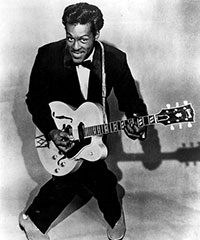
While artists such as Ray Charles were stitching gospel and rhythm and blues together, other artists in the rhythm and blues genre were taking stylistic gestures from early rhythm and blues artists such as Louis Jordan and adding electrified instruments and performance styles. These artists also borrowed performance elements from hillbilly music and country and western. One of the most important artists in this style of rhythm and blues was Chuck Berry, whom many historians consider to be the father of rock and roll.
Berry’s vocal delivery style was heavily influenced by country and western music.In fact, his delivery was so close to that of country singers that many listeners were surprised to learn that Berry was black.
Berry was already a veteran night club entertainer when he transformed "Ida Red ♫," a country and western tune that had been recorded by artists such as Bob Wills and Roy Acuff, to "Maybellene ♫" (1955). "Maybellene ♫" includes Berry’s basic guitar style, which was influential on many rock musicians. His introductions, double-note solos, and alternating accompaniment chords defined Berry’s style and influenced guitarists for generations to come. Further, Berry performed his famous "duck walk" during his guitar solos, a gesture which became an iconic part of his performances. Like many of his songs, "Maybellene ♫" borrows its harmonic structure from the 12-bar blues, but the song is in verse-chorus form, not the 12-bar blues form.
"Maybellene ♫" also established Berry’s poetic skill with lyrics. He treated topics that were of the utmost concern to the new teen culture in the United States, regardless of whether the listeners were black and white: cars, girl-boy problems, school, music, growing up, and parents. Tracks such as "School Day ♫," "Sweet Little Sixteen ♫," and "Johnny B. Goode ♫" are just a few examples. "Roll Over Beethoven ♫" mocks conservative adult culture, claiming that the excitement of rhythm and blues would probably cause the composer to roll over in his grave.
Berry was just one of several artists to achieve crossover success in the 1950s. A crossovera song that holds a prominent place on at least two of the three types of charts: pop, rhythm and blues, and country refers to a song that holds a prominent place on at least two of the three types of charts: pop, rhythm and blues, and country. The laid-back rhythm and blues pianist Fats Domino achieved crossover success with songs such as "Blueberry Hill ♫" and "Ain't That a Shame ♫," both of which charted on the rhythm and blues charts and then crossed over to the pop charts. Little Richard, a far more flamboyant performer than either Berry or Domino, crossed over from rhythm and blues to pop with songs such as "Long Tall Sally ♫" and "Good Golly Miss Molly ♫." Artists such as Little Richard and Big Joe Turner recorded songs that were often considered too explicit for pop (white) audiences. This led to the phenomenon of the cover version which will be discussed in the next lesson.



