
Overview
In the 1950s, disc jockey Alan Freed was an important figure in the promotion of African American popular music, and he began calling it “rock and roll.” Soon, white artists such as Bill Haley and His Comets and Pat Boone began recording cover versions of black artists’ songs, most of which were more commercially successful than their black counterparts. The most successful of all the early rock and rollers, of course, was Elvis Presley. Presley’s ascent to stardom in the 1950s secured the popularity and commercial viability of the genre of rock and roll.
Objectives
- Recall the technological changes and its impact in the music industry
- Examine the influence of disc jockey Alan Freed
- Identify various rhythm and blues artists
- Examine some of the ways that white artists modified the music of black artists in their cover versions
- Recall the music that Elvis Presley recorded during the 1950s
Sam Phillips and Sun Records
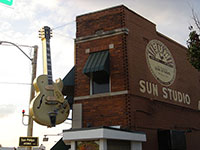
In 1950, Sam Phillips started the Memphis Recording Studio, which was the only convenient recording studio for Memphis blues artists. Phillips recorded artists such as B.B. King, Little Walter, and Howlin’ Wolf simply because he offered one of the few available recording spaces. Although Phillips initially leased his masters to the Chess and Modern labels, he eventually launched his own label, Sun Recordsrecord company launched by Sam Phillips in 1952; located in Nashville, in 1952.
Presley recorded ten sides for Sun Records before his contract was sold to RCA-Victor. These recordings do not feature a drum set but instead, include only Presley with musicians Scotty Moore on electric guitar and Bill Black on string bass. None of these recordings include a drum set because drums were typically associated with rhythm and blues, and Moore and Black were country musicians. Presley’s first single for Sun Records included "That's All Right ♫" and "Blue Moon of Kentucky ♫." Other Sun recordings such as "Mystery Train ♫" and "Blue Moon ♫" were covers of blues songs, country and western numbers, and Broadway songs.
He was initially billed as "The Hillbilly Cat" or "The King of Country Bop," both titles attempting to convey his simultaneous country and rhythm and blues sounds. Presley’s Sun recordings were marketed as country, although they combined country with rhythm and blues. According to Sam Phillips, "I recall one [disc] jockey telling me that Presley was so country he shouldn’t be played after 5 AM. And others said he was too black for them." Phillips knew that he had a star in the making, but he had to figure out how to market him. According to Phillips’s secretary, "Over and over, I remember Sam saying, ‘If I could find a white man who had the Negro sound and the Negro feel, I could make a billion dollars.’"
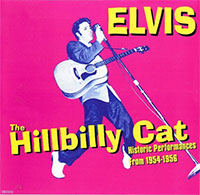
Regardless of the marketing dilemma, Presley’s music quickly became infectious. Sam Phillips sent a recording of Presley’s "That's All Right ♫" to the disc jockey Dewey Phillips, who ended up playing the record thirty times in a single night on his Red, Hot, and Blue radio show. Bill Randle, a Cleveland disc jockey, played one Presley recording every fifteen minutes all weekend long. According to Randle, "I don’t know what those Presley records have, but I put them on yesterday, and the switchboard lit up like Glitter Gulch in Las Vegas. He hits them [the kids] like a bolt of electricity. My phone hasn’t stopped ringing and I haven’t been able to stop playing those records." This hybridity of styles contributed to what is now known as the rockabilly style, which we will focus on in greater detail in later lessons.
Regardless of the marketing dilemma, Presley’s music quickly became infectious. Sam Phillips sent a recording of Presley’s "That's All Right ♫" to the disc jockey Dewey Phillips, who ended up playing the record thirty times in a single night on his Red, Hot, and Blue radio show. Bill Randle, a Cleveland disc jockey, played one Presley recording every fifteen minutes all weekend long. According to Randle, "I don’t know what those Presley records have, but I put them on yesterday, and the switchboard lit up like Glitter Gulch in Las Vegas. He hits them [the kids] like a bolt of electricity. My phone hasn’t stopped ringing and I haven’t been able to stop playing those records." This hybridity of styles contributed to what is now known as the rockabilly style, which we will focus on in greater detail in later lessons.
Although these early recordings at Sun Records were an important part of Presley’s career and output, he did not achieve his meteoric rise to superstardom and international celebrity until he began working with Colonel Tom Parker.



