Overview
In the 1950s, disc jockey Alan Freed was an important figure in the promotion of African American popular music, and he began calling it “rock and roll.” Soon, white artists such as Bill Haley and His Comets and Pat Boone began recording cover versions of black artists’ songs, most of which were more commercially successful than their black counterparts. The most successful of all the early rock and rollers, of course, was Elvis Presley. Presley’s ascent to stardom in the 1950s secured the popularity and commercial viability of the genre of rock and roll.
Objectives
- Recall the technological changes and its impact in the music industry
- Examine the influence of disc jockey Alan Freed
- Identify various rhythm and blues artists
- Examine some of the ways that white artists modified the music of black artists in their cover versions
- Recall the music that Elvis Presley recorded during the 1950s
Colonel Tom Parker and Presley at RCA-Victor
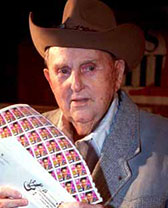
The disc jockey Bob Neal had been serving as Presley’s manager until 1955, when Colonel Tom Parker stepped in and transformed Presley’s career. Parker brokered a deal and sold Presley’s contract to RCA-Victor for an astronomical $35,000, plus $5,000 in back royalties. To Parker, Presley could not achieve national success unless he left Sun Records.
The importance of this transfer of Presley’s contract from Sun to RCA-Victor cannot be overstated. In the mid-1950s, major record labels were not interested in rock and roll because they thought it was a fad. By buying Presley’s contract for an unheard-of sum of money, RCA showed the recording industry that the times were changing.
Soon after Presley began recording for RCA, the other major record labels began adding rock and roll musicians to their rosters. Soon, rock and roll was squarely in the center of mainstream popular music.
RCA set about transforming the Hillbilly Cat into a mainstream pop star. The first recording Presley made for RCA, "Heartbreak Hotel ♫" (1956), held the number one spot on the pop charts for eight weeks. Later in 1956, the double-sided hit "Hound Dog ♫" and "Don't Be Cruel ♫" went to number 1 on the pop charts, the country and western charts, and the rhythm and blues charts simultaneously. This was the first record to achieve this level of crossover success. It was not uncommon for artists such as Chuck Berry or Bill Haley and His Comets to occupy space on both the pop and rhythm and blues charts, or on the pop and country and western charts, but until Presley, it was unheard of for an artist to not only cross over to all three charts, but also to hold the number one spot on all of those charts.
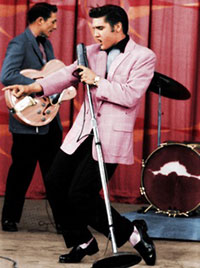
In 1956, Parker secured several important television appearances for Presley. He scandalized audiences on Milton Berle’s program when he swiveled his hips and quaked his entire body during the performance, exciting the studio audience and infuriating the national media. Steve Allen neutralized some of Presley’s sex appeal by asking him to sing "Hound Dog ♫" to an actual basset hound during the singer’s appearance on his show. Perhaps the most famous attempt to tame Presley’s sexuality came when he appeared on the Ed Sullivan Show and was filmed only from the waist up. These limitations did nothing to staunch Presley’s popular appeal and the throngs of screaming fans.