
Overview
As British bands absorbed the sounds of American rock and roll and its predecessors, they also forced American rock bands to reconsider their own sounds and approaches to music. Some artists in the mid-1960s held tight to older ideas and formulas, sometimes with great success. For example, songwriting duo Jerry Leiber and Mike Stoller continued to pen hits during the 1960s, such as “Chapel of Love,” recorded by the Dixie Cups, and “Leader of the Pack,” recorded by the Shangri-Las. At the same time, new types of bands gained popularity in the American market, demonstrating that garage bands, folk rock, and blues revival groups could be a formidable presence on the American record charts.
Objectives
- Identify several artists and types of rock that became popular soon after the British Invasion
- Recall why garage bands, TV rock, the American blues revival, and folk music gained commercial viability in the middle of the 1960s
- Examine how rock music began to diversify following the British Invasion
Rock Made for TV continued
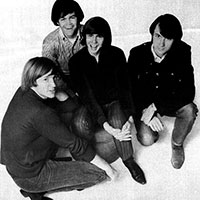
"Last Train to Clarksville ♫" (1966) was the Monkees’ first single, and it quickly went to number 1 on the Billboard Hot 100 chart. Written by the songwriting and production team of Tommy Boyce and Bobby Hart, "Last Train to Clarksville ♫" largely follows the Brill Building formula. The song is in simple verse form, but unlike most pop songs of the time, each verse is a different length. The guitar licks and the guitar timbre in the song echo those of Beatles hits such as "Day Tripper ♫," "I Feel Fine ♫," "Paperback Writer ♫," and "Ticket to Ride ♫." All of the instrumentals in the song are performed by studio musicians, not by the members of the Monkees.
Although the members of the Monkees were originally four actors who had been cast to play the members of a Beatles-like band, by the late 1960s, the Monkees had become an actual band. Both Tork and Nesmith were songwriters and guitarists, although they were rarely invited to play on the early recordings made by the Monkees. The members of the Monkees began fighting for the right to produce their own songs and to supervise all of the music that was released under the band’s name. Essentially, the Monkees wanted to make the change from fictitious television band to an actual rock band. In 1967, only four months after the premiere of the television show, the Monkees had their first recording session at RCA studios as a self-contained band. "The Girl I Knew Somewhere ♫," which was written by Nesmith and recorded during this session, became a Top 40 hit single. Other songs, such as "A Little Bit Me, A Little Bit You ♫," (a cover of a song by Neil Diamond) also had modest successes. Over time, the band began writing and recording songs that increasingly showed the influences of country and folk music. For example, "You Told Me ♫" includes a banjo.
In subsequent seasons of The Monkees, the band members played all of the songs themselves with the occasional inclusion of session musicians when necessary. "Daydream Believer ♫," released in 1967, is a good representation of the music that was recorded by this later version of the Monkees. The song was written by John Stewart, not by the Monkees, but Tork provided the arrangement of Stewart’s song that the band recorded. Tork also played piano on the recording, with Nesmith on lead guitar, Jones on lead vocals, and Dolenz on backing vocals. The Monkees had accomplished a rather remarkable feat because they became the characters they played on television. These four young men had transformed themselves from fiction into reality.
The success of the Monkees inspired a number of other rock bands that were made for TV. For example, in the 1970s, The Partridge Family television show featured everyone’s favorite fictional band, fronted by teen heartthrob David Cassidy. Unlike the Monkees and the Partridge Family, however, many of these later made-for-TV bands were cartoons or people in costumes, probably because a cartoon band was unlikely to lobby for the rights to its own music. The show The Banana Splits Adventure Hour featured the band the Banana Splits, whose members included Fleegle, Bingo, Drooper, and Snorky. The members of the band were played by costumed musicians, and the show’s theme song, "The Tra La La Song (One Banana, Two Banana) ♫," managed to crack the Billboard Top 100 in 1969. The Archies were a band created by Don Kirschner that included the characters Archie, Reggie, and Jughead from the animated television show The Archie Show. (The show was based on the Archie comics.) The Archies’ music was written by Jeff Barry and performed by studio musicians, but they still had several hits on the American charts, such as "Bang Shang a Lang ♫" and "Sugar Sugar ♫." Perhaps strangest of all of these made-for-TV bands was the Evolution Revolution, an all-chimpanzee band who appeared on the show Lancelot Link, Secret Chimp. Clearly, by the late 1960s, rock and roll had become more than a musical phenomenon. It was a media empire, capable of creating new stars, bringing television shows to life, and even creating hit music for fictional characters.



