
Overview
The mid-1960s were a time of upheaval for young people in the United States. The Civil Rights Movement, protests against the Vietnam War, and the movement for women’s rights inspired many people to become suspicious of the American institutions that they were supposed to trust. This distrust and sense of separation led to the development of a countercultural movement that was passionate about maintaining its distance from the mainstream. In particular, many young people sought a new vantage point from which to view the world. In response, musicians began recording psychedelic rock, which was also intended to change the listener’s consciousness or point of view.
Objectives
- Examine how and why psychedelic music became popular in the mid-1960s
- Recall how the Beach Boys changed their earlier styles of music and began recording psychedelic rock
- Recall how guitarists such as Jimi Hendrix experimented with distortion and feedback to create new sounds on the electric guitar
- Recall how new recording techniques, instruments, technologies, and lyric sources all guided these musicians as they began explore different modes of expression and realms of consciousness in their music
- Examine the Woodstock Music and Art Festival of 1969, regarded as the pinnacle of the music and culture of the late 1960s
Psychedelic Rock
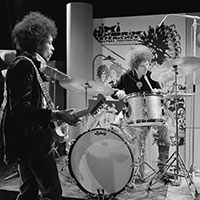
Jimi Hendrix is widely regarded as the single most influential rock guitarist of all time. In the 1960s, Hendrix was considered one of the first so-called "guitar heroes" of rock music because he was famous as guitar a soloist and inspired cult-like followings of guitar players who wanted to emulate his styles.
During the 1960s, Hendrix played in various bands in New York, but he first became famous in London. There, Hendrix formed a band called the Jimi Hendrix Experience, which featured Mitch Mitchell on drums and Noel Redding on bass. The Jimi Hendrix Experience was a power trio, which meant that the music focused on only three instruments: guitar, bass, and drums. Hendrix was able to combine the sounds of rhythm guitar and lead guitar on a single instrument.
The band's first album, Are You Experienced? (1967), was a huge hit in the United Kingdom and a modest success in the United States. In fact, Are You Experienced? was second only to the Beatles' Sgt. Pepper's Lonely Hearts Club Band on the UK charts.
Hendrix was electrifying to watch in live performances. Brian Jones of the Rolling Stones called Hendrix "the most exciting performer I have ever heard." Hendrix played the guitar upside down because he was left-handed (he had taught himself to play this way without realizing that left-handed guitars existed, and he simply never made the change to a left-handed guitar). He preferred the Fender Stratocaster, and his left-handed playing produced a different sound than was typically heard from other musicians who played Fender Stratocasters: because he restrung the instrument to play it left-handed, the lowest string had a bright sound and the lowest string had a dark sound, which was the opposite of how the instrument had been designed to sound. Hendrix would frequently play his guitar behind his back or over his head, or he would use his teeth on the strings. His use of feedback, his high-volume playing, and his use of the wah-wah pedalan effects pedal for the guitar which alters the guitars tone, creating a “wah-wah” sound; this pedal was used extensively by Eric Clapton and Jimi Hendrix were also definitive aspects of his style. Often, Hendrix would stroke the neck of the guitar along the microphone stand. Hendrix's performances were sexually flamboyant and aggressive; he treated his guitar as a phallic extension of his own body. He prayed to his guitar. Often, he would set his guitar on fire or otherwise destroy it by the end of a performance. In 1966, Hendrix shared the stage with Eric Clapton's band Cream at the London Polytechnic Club; recalling the performance, Clapton said, "My life was never the same again."



