
Overview
In the early 1980s, the massive deregulation of television broadcasting led to an expansion of cable TV services throughout the United States. These cable providers carried a number of specialized channels for their subscribers. On August 1, 1981, Warner Communications and the American Express Company launched MTV, the first 24-hour music video cable channel. By 1983, MTV had expanded from 2.5 million initial subscribers to 17 million, making it the fastest growing cable channel in history. Airing videos on MTV was a way for artists and record companies to promote their music. By 1983, nearly all of the albums on the Billboard albums chart had at least one song in heavy rotation on MTV. MTV became the new way to advertise music to consumers.
Objectives
- Recall the development of MTV during the 1980s
- Examine the significance of the Second British Invasion as it related to MTV
- Examine the role Michael Jackson played in eliminating the color lines on MTV
- Recall how Madonna pushed musical and visual boundaries in her music and videos
Sex, Feminism, and MTV: The Case of Madonna
As we saw in the case of Duran Duran, sexy music videos with beautiful men and women were very popular on MTV. But, like the video for Duran Duran's "Girls on Film ♫," a number of music videos by male artists were accused of objectifying women. The majority of MTV viewers in the station's early days were young, white males, and many music videos catered to their sexual and commercial desires. In the music video for "Centerfold ♫" by the J. Geils Band (1981), the classroom in which the video is set gradually fills up with cheerleaders and women wearing negligees, while in the video for Robert Palmer's "Addicted to Love ♫" (1986), Palmer is backed by a band of models who are scantily clad and heavily made up. Most directors of music videos had backgrounds in advertising, and they knew that sex would sell the albums and singles as predictably as it would sell clothing or cars.
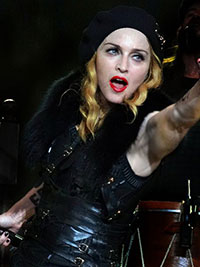
The singer, songwriter, and performer Madonna frequently drew criticism for her music videos, which ran from suggestively erotic to explicitly sexual. Her music was both popular and incendiary, and she was alternately called a feminist and a terrible role model for women. She drew criticism from parents' groups and the Vatican, and she outsold every other recording artist in the 1980s except Michael Jackson. Like Jackson, the majority of Madonna's music is dance-oriented and prominently features synthesizers. Madonna's first two music videos were for "Lucky Star ♫" (1983) and "Borderline ♫" (1984). The video for "Lucky Star ♫" included glimpses of Madonna's navel, which was a precursor of the increasingly explicit sexuality that she would portray in her videos.
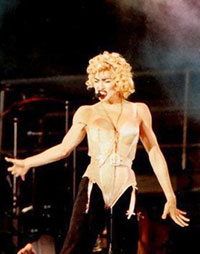
In 1984, Madonna released her second album, Like a Virgin. She promoted the album by releasing several singles, all of which had videos on MTV. The videos then created a tie-in for the staged concert tour of the album, which was called the Virgin Tour. In the music video for "Like a Virgin ♫," which was directed by Mary Lambert, Madonna wandered through streets and marble rooms in Venice while wearing a wedding dress, and then she dances and writhes in a gondola while wearing a number of crosses and other symbols of Christianity. Family organizations called for a ban of the song and the video, claiming that "Like a Virgin ♫" undermined family values. Madonna's explicit recordings were a catalyst for the creation of the Parents' Music Resource Center in 1985. The PMRC advocated for a ratings or warning system in music similar to that in the film industry. The music industry began placing parental warning labels on albums and songs during the late 1980s.
Madonna continued to push the boundaries during the late 1980s and early 1990s. Her video for "Express Yourself ♫" (1989) features her in men's clothing in one scene and wearing a dog collar in the next. The video for "Like a Prayer ♫" (1989), features burning crosses, interracial sex, a black Jesus, and masturbation in a church pew. The Vatican censured the "Like a Prayer ♫" video, and Pepsi canceled an endorsement deal with Madonna in the wake of the video's controversy.
It is important to note that Madonna did not operate at the behest of a producer or a director. She had full artistic control over both her music and her videos. From the beginning of her career, she wrote or co-wrote most of her songs and was an active participant in the production of the albums. In an interview, Madonna argued that she was a feminist because she made her own decisions: "Isn't that what feminism is all about? Equality for men and women? And aren't I in charge of my life, doing the things I want to do and making my own decisions?"

“He revolutionized music videos. Before Michael Jackson, MTV refused to play African-American artists.”


