
Overview
In the late 1970s and early 1980s, several British and American bands brought increasing diversity to heavy metal. This new approach to heavy metal still had the weight and riff-based sound of earlier heavy metal, but it was infused with the speed and anger of punk rock. In this lesson, we will trace several major developments in heavy metal, beginning with the second generation of British heavy metal musicians and then observing a number of subgenres of American heavy metal.
Objectives
- Recall the new developments in heavy metal music that occurred in the mid-1970s in the music of bands such as Motörhead
- Identify several significant American and British heavy metal bands from the early 1980s
- Recall the major subgenres of heavy metal, including hair metal and thrash metal, and discuss the stylistic characteristics of each
Hair Metal
Other American heavy metal bands emerged in the 1980s that had crossover appeal with popular music audiences. Like Van Halen and Guns N' Roses, Mötley Crüe was founded in Los Angeles. The members of Mötley Crüe included singer Vince Neil, guitarist Mick Mars, bassist Nikki Sixx, and drummer Tommy Lee. In their music, music videos, and personal lives, the members of Mötley Crüe displayed their love for women, alcohol, drugs, decadence, and outrageous sexual escapades. In concert, they wore boots with high heels, heavy makeup, teased hair, and costumes with spandex and spikes.
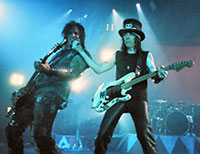
The group's appearance inspired a new designation called hair metala genre of metal popular in the 1980s consists of bands wearing heavy makeup, teased hair, and costumes with spandex, songs about partying and having a good time, and a more pop-oriented approach the music than that of other metal genres or glam metal. Hair metal refers to the group's love of heavily teased hairstyles, but the designation also describes the music of Mötley Crüe and other expertly-coiffed bands of the period. Hair metal bands typically sang about partying and having a good time, and their music was more pop-oriented than that of some other metal bands.
Mötley Crüe's "Shout at the Devil ♫" was released as a single in 1983. The music is still guitar-oriented and the drums are heavy, but the choruses are anthem-like and designed to encourage the listener (or live audience) to sing along. Neil's voice is high in pitch and at times borders on a scream, which is reminiscent of the vocal style of Led Zeppelin's lead singer Robert Plant. Toward the end of "Shout at the Devil ♫," the guitars drop out and leave only the vocals and drums; during live performances, the audience sings and claps along during this part.

Another popular hair metal band of the 1980s was the group Poison, also based in Los Angeles. Vocalist Bret Michaels, guitarist Matt Smith, bassist Bobby Dall, and drummer Rikki Rockett started the band in Pennsylvania in 1983, but they soon moved to Los Angeles to perform in the same clubs as Van Halen. Soon after arriving in Los Angeles, Smith left the group and was replaced by C.C. Deville on guitar. The members of Poison wore makeup and feminine costumes, and they even had their own hairdresser (Rockett had been a hairdresser before joining the band).
Poison's music was catchy, compact, and often demeaning to women. Songs like "Talk Dirty to Me ♫" (1987) and album titles such as Open Up and Say…Ahh! (1988) sold millions of copies and earned the band a strong female following, despite the fact that many of their lyrics and music videos were often considered sexist.


“People can talk about punk all they want, but after new wave put that down, metal is the voice of the disenfranchised and that need to become unhinged.”

