
Overview
By the late 1980s and early 1990s, hip-hop had become increasingly diverse in its sounds, styles, and messages. In this lesson, we will survey several major styles of hip-hop that were popular at the end of the 1980s, including political hip-hop, pop rap, gangsta rap, and sample-based hip-hop. By this time, hip-hop ran the gamut from family-friendly pop rappers such as MC Hammer to the hard, streetwise tales spun by the members of N.W.A.
Objectives
- Identify the characteristics of several styles and subgenres of hip-hop from the late 1980s and early 1990s, including political hip-hop, sample-based hip-hop, gangsta rap, and pop rap
- Recall the significance of sampling in the music of groups such as De La Soul, the Beastie Boys, and Public Enemy
- Recall why some pop rap artists such as MC Hammer were accused of “selling out” when their music had crossover appeal
Sample-Based Hip-Hop continued
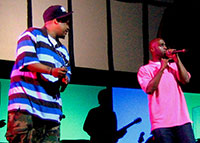
Another group who sampled generously in the late 1980s was De La Soul, whose members included rappers Posdnous, Trugoy the Dove, and Maseo, as well as producer Prince Paul. De La Soul's first album, released in 1989, was 3 Feet High and Rising, the title of which is a play on the name of the Johnny Cash song "Five Feet High and Rising ♫" (1974). De La Soul sampled every kind of sound imaginable in their music, including funk, soul, hip-hop, country, stand-up comedy, pop, jazz, and foreign language instruction records.
No artist's music was off limits, and De La Soul placed the sounds of artists as diverse as Kraftwerk, Sly and the Family Stone, the Monkees, Led Zeppelin, Funkadelic, and Wilson Pickett in a sonic blender and created a completely new sound from fragments of these recordings. "The Magic Number" layers looped drum samples from Led Zeppelin's "The Crunge ♫" (1973) with samples of instruments from funk artists Syl Johnson, James Brown, and the Fatback Band. De La Soul then interpolates various samples of voices and lyrics from sources including Johnny Cash, comedian Eddie Murphy's stand-up, a 1940s radio advertisement, and the children's television show Schoolhouse Rock! In the song's lyrics, each of the three members of De La Soul claims that "three is the magic number" and provides various pieces of evidence for their assertion, the most obvious of which is the fact that there are three rappers in the group. The members of De La Soul rapped about offbeat and quirky topics, which, combined with their eclectic and eccentric sampling, made them one of the most distinctive hip-hop groups of the late 1980s. Critic Robert Christgau called De La Soul's music the "New Wave to Public Enemy's punk."
The sample-based sounds heard in the music of De La Soul, the Beastie Boys, and Public Enemy did not last long. As hip-hop became increasingly popular and commercially viable, record companies became stricter about sample licensing. Many of these early albums either did not license any of their samples or only licensed a few, which attracted lawsuits from recording artists whose music had been sampled but had not been licensed or credited. Both De La Soul and the Beastie Boys had been sued by other record companies for copyright infringement, and they settled out of court for generous, undisclosed sums. By the early 1990s, it was financially impossible to create albums such as Fear of a Black Planet, Paul's Boutique, and 3 Feet High and Rising because the musicians could not afford to license the hundreds of samples used in their music. As a result, the musical styles of these groups and others changed significantly during the 1990s because they used fewer samples in their music.


"Gangsta rap often reaches higher than its ugliest, lowest common denominator, misogyny, violence, materialism and sexual transgression are not its exclusive domain. At its best, this music draws attention to complex dimensions of ghetto life ignored by most Americans. Indeed, gangsta rap's in-your-face style may do more to force America to confront crucial social problems than a million sermons or political speeches."

