
Overview
In the late 1980s and early 1990s, many rock musicians wrote and recorded music that was closely aligned with rock genres and styles of the past. Britpop bands echoed the music of the British Invasion. Industrial rock artists took the darkness of heavy metal and combined it with the abstraction of the Velvet Underground. Pop punk bands recorded and released music that was the most commercially successful music by any punk rock artist in history. At the same time that these and other bands were absorbing and redefining rock traditions, listeners were engaging with new forms of listening technology in the forms of CDs and MP3s.
Objectives
- Recall the changes that occurred in commercial recording technology during the 1980s and 1990s
- Recall the important people and stylistic features of Britpop, industrial rock, and pop punk
- Examine how Britpop, industrial rock, and pop punk music related to earlier styles and genres of rock music
Britpop
During the 1990s, several British bands began recording music that was influenced by and reminiscent of the Beatles' music from the early part of the 1960s. Critics dubbed this style of British rock "BritpopBritish bands of the 1990s that recorded music that was influenced by and reminiscent of the Beatles’ music from the early part of the 1960s; examples include Oasis and Blur." Britpop bands returned to the two guitars, bass, and drum set of early Beatles music, and they used very few studio effects or post-production techniques in their music. Although several Britpop bands were very successful in the United Kingdom, in the United States, the most popular of the 1990s Britpop bands was Oasis.
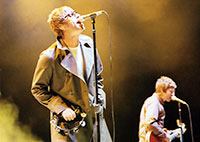
During the 1990s, the members of Oasis included brothers Liam Gallagher (vocals) and Noel Gallagher (vocals and lead guitar), as well as guitarist Paul Arthurs, Paul McGuigan (bass), and Tony McCarroll (drums). Their albums (What's the Story) Morning Glory? (1995) and Be Here Now (1997) sold millions of copies in both the United States and the United Kingdom. The single "Wonderwall ♫" from (What's the Story) Morning Glory features Liam Gallagher as the lead singer, and Arthurs playing the Mellotron, a gesture hearkening back to the sounds of rock from the 1960s. Further, the title of the song was inspired by the 1968 film Wonderwall, for which George Harrison of the Beatles provided the soundtrack. The Gallagher brothers quarreled publically and frequently. They often disputed about which one would sing the lead vocals in the music they had written, and their fights often ended in violent confrontations.
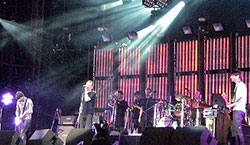
During the 1990s, Oasis often battled with the band Blur for the title of the top Britpop band. Formed in the late 1980s, Blur's members include singer and keyboardist Damon Albarn, singer and guitarist Graham Coxon, bassist Alex James, and drummer Dave Rowntree. Their single "Country House ♫" (1995) was released on the same day as "Roll With It ♫" by Oasis, which created a media sensation in Britain that journalists dubbed "the battle of Britpop." In the end, Blur's single outsold Oasis's, but the album The Great Escape (on which "Country House ♫") appeared was thoroughly outsold by the Oasis album (What's the Story) Morning Glory?
Following their unsuccessful battle with Oasis, the members of Blur changed artistic directions. They created a low fidelity, stripped-down sound in their next album, Blur (1997). Their sound was more straightforward and they avoided most elaborate post-production techniques and effects, which can be heard in singles such as "Beetlebum ♫" and "Song 2 ♫." Blur was not nearly as popular in the United States as Oasis was, but a few of their singles, one of which included "Song 2 ♫," charted in the United States during the 1990s and early 2000s.

“In the '90s, the radio was still alive with all different kinds of points of view, and I think that's why people are longing for that time. It was the first time that alternative music broke through to the mainstream.”


