
Overview
In this lesson, we will consider several musical responses that occurred in the wake of September 11, 2001. One corporation banned songs that it thought would be controversial or upsetting, igniting accusations of censorship. Several country musicians recorded anthems that promised revenge on those who had wronged the United States, and these songs were received with varying degrees of acceptance by listeners and by other musicians. Finally, the outspoken members of one band found themselves at odds with both corporations and their fellow country musicians when they criticized President George W. Bush. The controversies presented in this lesson raise questions about free speech, censorship, and the effects music can have in response to tragedy.
Objectives
- Recall the music that Clear Channel suggested that its radio stations not play after 9/11
- Recall the musical responses of several country music artists in response to the events of 9/11
- Recall the controversies surrounding the Dixie Chicks and their statements about other musicians and the American president
Conclusion
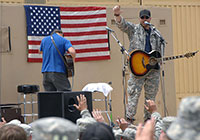
After 9/11, musicians and music corporations responded in many different ways. Clear Channel Communications asked its radio stations not to play a list of songs that it had deemed inappropriate. These songs were determined to be inappropriate for many different reasons, and critics accused Clear Channel of censorship and of exercising too much control over what its listeners could hear on the radio. Specific songs addressed the grief of 9/11 and the desire for revenge against those who had attacked the United States, such as Toby Keith's "Courtesy of the Red, White, and Blue (The Angry American) ♫" and Clint Black's "I Raq and I Roll."
Individual musicians also spoke out against what they perceived as inappropriate action on the part of the United States. The most outspoken musician was Natalie Maines of the Dixie Chicks, who publicly criticized both President George W. Bush and her fellow country artist Toby Keith. All of the examples discussed in this chapter related to corporations, listeners, and musicians reacting to tragedy as well as reacting to each other's reactions to tragedy.

"There is no question that the US market is the hardest to break into. I believe that the reason for this primarily has to do with the fact that the majority of the most powerful radio stations in the US are owned by Clear Channel. They are massive and have the ability to break artists worldwide. For the most part, they are dealing directly with the major labels in the US, with whom they have had long relationships. If you are an artist that is not being pushed by Clear Channel radio in the US, your chances of becoming a household name are slim."


