
Overview
Music is an ever changing expression of the time, place, and people who create it. In the border areas of Mexico and the U.S. and in Mexican-American populations around the country, unique musical forms and styles have been developed to entertain, educate and uplift audiences. In this chapter we will discuss the genre of conjunto in its traditional and modern forms in Texas. These musical styles appeal to the working class and function in large part to accompany couple dancing. Forms will include the popular polka dance, the corrido (a type of narrative ballad) and the ranchera, (a popular type of Mexican song). The development of the traditional conjunto ensemble will be traced from the early 1900s through the 1960s. Examples are given of innovative hybrid musical styles formed in combination with mainstream popular music and Latin American music of recent years. Most of the music is sung in Spanish with the exception of some cross-over English songs.
Objectives
- Identify the ensembles and selected genres and forms of Conjunto aurally
- Recall the bajo sexto and accordion and their musical roles and functions
- Identify the following song/dance forms: polka, corrido, ranchera, cumbia
- Recognize the major artists of Conjunto music
- Analyze the cultural context that these ensembles, genres, and forms originate from as part of an ongoing, bi-cultural musical expression
Corrido
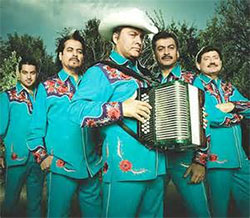
A primary song form performed by the conjunto is the corrido, a narrative ballad descended from the Spanish Romance form that tells a story. Its structure consists of stanzas of four lines, with eight syllables each, in which the 2nd and 4th lines rhyme. It is set to a waltz (3/4) or polka (2/4) beat, and in the 19th century, revolutionary figures and outlaws were popular topics. The corrido became a powerful symbolic expression of the Tejano's struggle to negotiate conflict with Anglos, including economic disparity. By the 1860s the corrido vibrantly expressed this and continued to be popular during the Mexican Revolution. Local men and women were glorified as heroes in corridos of this time period, and in later decades,
leaders of the working class such as Cesar Chavez were paid tribute. Anti-heroes such as drug smugglers are featured as subjects of the narco-corrido and sung by prominent performing groups like Los Tigres del Norte. Other recorded corridos expound on Mexican pride and give voice to immigrants facing discrimination in America. It is important to note that some corridos are purely fictional and written for their commercial potential only while many recount actual historical events. Overall, corridos are closely connected with the popular music and literature of the communities they come from.
The first recorded corrido is called Gregorio Cortez ♫, which has an outlaw/hero subject. The historical event of the arrest and trial of Gregorio Cortez is told, who, in 1901, stood up to the authorities and evaded capture by a large posse of rinches (Texas rangers). Historically, Cortez was wrongfully accused of stealing a horse by Sheriff Morris in Karnes county. A simple misunderstanding due to language differences resulted in a shootout. Sheriff Morris shot Cortez's brother Ramaldo, and was in turn shot and mortally wounded by Cortez. Cortez took care of his brother, then fled north on foot to near Ottine. Here the rinches attempted to arrest him again during which another posse member was killed by a drunken deputy and Cortez escaped. Cortez then headed south towards the Rio Grande with several hundred men out looking for him. On horseback he rode on, sleeping in Cotulla. Here he was spotted and turned in for a $1,000 reward by Jesús Gonzalez, to the Texas Rangers. Jailed in San Antonio, he went through a series of trials. First, he was given 50 years on a charge of 2nd degree murder for the death of posse man Henry Schnabel. At the next trial he was sentenced to 2 years for horse theft, which was later reversed. The case was tried again at Corpus Christi, where a jury of Anglo farmers found him not guilty in the death of Sheriff Morris. The verdict was a victory for Mexicans all over Texas. However, Cortez was found guilty of the murder of Sheriff Glover and given a life sentence. Eight years later, he was pardoned by Governor Colquitt and released. He died in 1916.

"Lydia sang in the vernacular, which means in the peoples' way of singing, not the highly trained or theatrical performers,"


