
Overview
In this lesson we will look at several types of popular music from the nineteenth century, including many different types of parlor songs. All of this music was available to purchase as sheet music, and it could be performed at home. Domestic music-making was an important part of American musical life during the nineteenth century, and performing music was an acceptable pastime for women. As we will see, sheet music was carefully marketed toward different types of audiences in order to ensure maximum commercial appeal. In addition to purchasing sheet music to play at home, people also enjoyed attending blackface minstrel shows, which were the most popular form of live entertainment during the nineteenth century.
Objectives
- Recognize the earliest types of American popular music and how this music was written and sold to be played and performed
- Identify examples of different types of parlor songs
- Examine music-making before the advent of recording technology
- Define blackface minstrelsy
- Identify the renowned figures in blackface minstrelsy
Blackface Minstrelsy
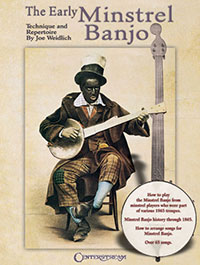
Blackface minstrelsy is simultaneously fascinating and troubling because it was a genre built on the misrepresentation and exploitation of African American music and culture. On the surface, a blackface minstrel show was a variety show that involved music, comedy sketches, social commentary, and slapstick comedy. The performers were white men who costumed themselves as caricatures of African Americans, covering their skin color with grease or burned cork and behaving in grotesque parodies of what they considered African American mannerisms. They spoke and sang in dialect that bore little resemblance to how black people actually spoke. In addition to making fun of black people, the white performers adopted these blackface personae in order to deliver social commentary on social and political issues.
For example, by speaking in dialect, the performers could mock politicians or society’s elite without the same repercussions that they might have faced by stating their opinions outright. By hiding behind a black mask, performers felt freer to speak what they saw as the truth about culture and society during the nineteenth century.
Some minstrel show stock charactersRecurring familiar characters in minstrel shows, such as Zip Coon and Jim Crow were so popular that no minstrel show seemed complete without them. Zip Coon, for instance, was an effete, dandified character who was pretentious and overdressed for every occasion. He was often presented in contrast to Jim Crow, a Southern plantation worker whose ignorance was matched only by his arrogance. Jim Crow was such a well-known character that the racial segregation laws enacted in many Southern states were called "Jim Crow laws" in the nineteenth and twentieth centuries.
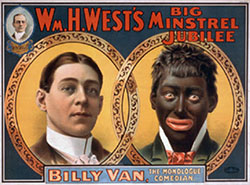
By the 1840s, minstrel shows were full-length affairs that lasted for an entire evening. The very first full-length minstrel show was presented in 1843 by a group of four musicians in blackface who billed themselves as the Virginia Minstrels. Playing the fiddle, banjo, tambourine, and bones, the musicians were seated in a semicircle on the stage. In addition to playing and singing songs, they danced, acted out skits, and interacted with their audiences. Dan Emmett, one of the members of the Virginia Minstrels, wrote a number of songs that the troupe performed in its shows, such as "Old Dan Tucker ♫" and "Dixie ♫." Dozens of minstrel companies sprang throughout the United States, touring both within their own cities and all over the country. Minstrel troupes were so popular that by 1844, a troupe called the Ethiopian Serenaders were invited to perform their show at the White House.
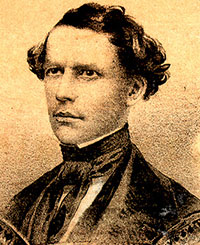
Christy’s MinstrelsHeaded by impresario and performer E.P. Christy, this was the most famous and successful minstrel troupe of the nineteenth century., a minstrel troupe that was headed by impresario and performer E.P. Christy, was the most famous and successful minstrel troupe of the nineteenth century. Christy managed the group, but he also served as the master of ceremonies, played banjo, and sang during the shows. Christy marketed his troupe’s shows as an inexpensive form of family-friendly entertainment, and Christy’s Minstrels performed for seven years at New York’s Mechanics’ Hall. A shrewd businessman, Christy quickly identified a young songwriter named Stephen Foster who was very talented but who needed an opportunity to showcase his songs. Foster and Christy entered into an agreement by which Christy's Minstrels had first-performance rights to all of Foster's new songs, which gave Foster's music enormous exposure. Audience members who enjoyed hearing Foster’s songs during a performance by Christy’s Minstrels could then purchase their own copy of the sheet music. This arrangement was lucrative for both Foster and Christy.
Although the songs from minstrel shows were often called "Ethiopian songs" or "plantation melodies," the music was neither African nor African American. The vast majority of blackface minstrel songs were in verse-chorus forma song form that contains two contrasting musical sections, called verse and chorus, that alternate; the verse sections have the same music but different lyrics each time they are repeated while the chorus sections repeat both the music and text, in which each verse has the same music but a different text, and each chorus has the same music and the same text. The choruses were often very catchy, encouraging audience members to sing along. In live performances, the minstrel songs were accompanied by banjo, fiddle, tambourine, and other small percussion instruments such as bones or shakers. When the songs were sold as sheet music, however, they were typically written as a solo song with a piano accompaniment. Most people did not have a banjo or fiddle at home to recreate the music exactly as they heard it in a minstrel show, but they did have pianos, which allowed them to perform their own rendition of the music.
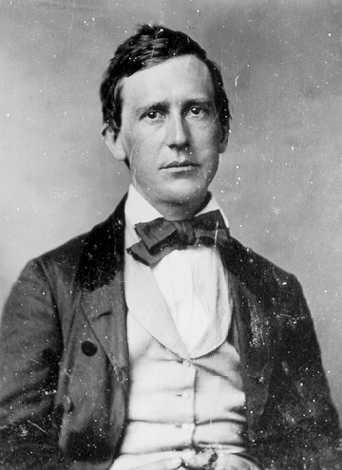
Foster’s "De Camptown Races ♫" is typical of minstrel songs of the period, with a catchy, jaunty melody and an enthusiastic chorus melody. "De Camptown Races ♫" features interactions between the soloist and the chorus, with the chorus frequently interjecting, "Doo-dah! Doo-dah!" during the verses. From the title alone, we can see that "De Camptown Races ♫" also drew its lyrics from dialect.
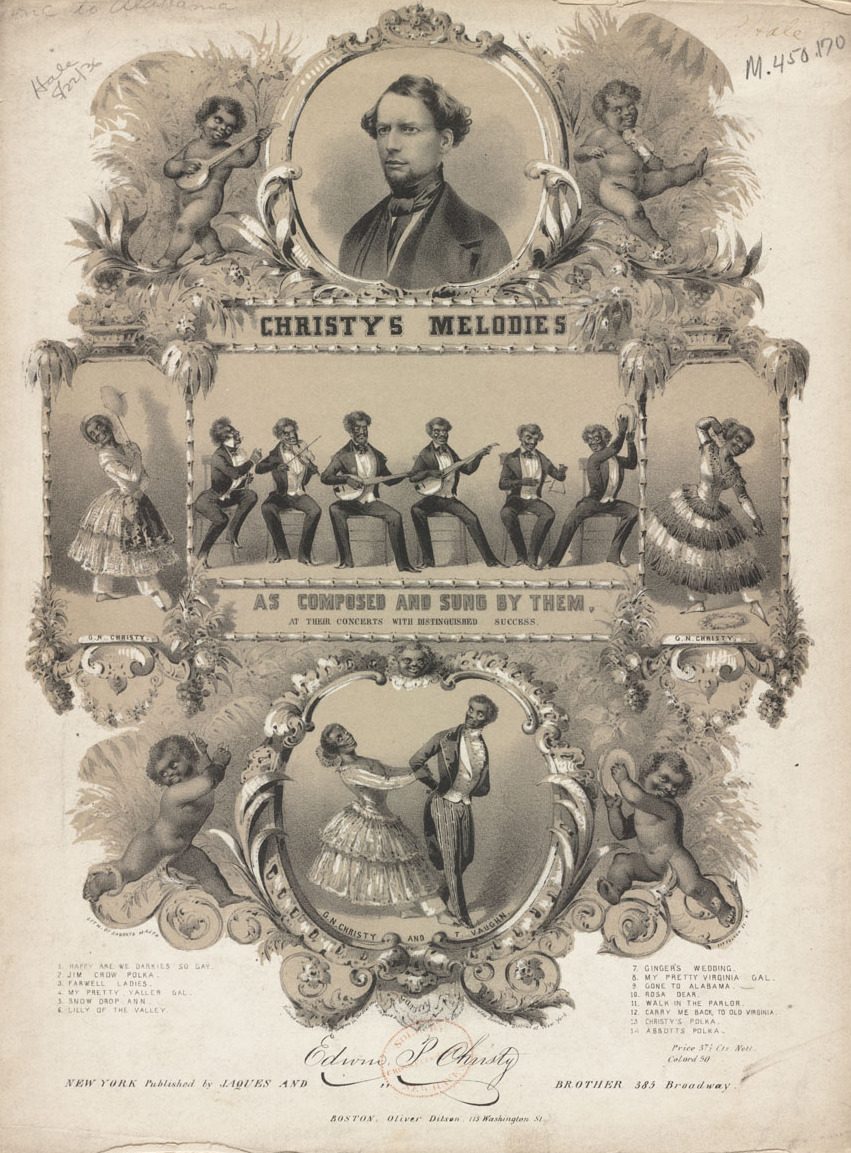
The relationship between Foster and Christy highlights some competing interests in music publication and promotion during the nineteenth century. Some of Foster’s most famous songs were originally written for Christy, including "De Camptown Races ♫," "O, Susanna! ♫" and "Old Folks at Home ♫" (better known as "Swanee River"). Foster, initially ashamed to have his name associated with minstrelsy and its music, allowed Christy to claim authorship of his music, and Christy’s name, not Foster’s, appeared on the sheet music versions of his songs. After Foster allowed Christy to claim authorship of his song "Old Folks at Home ♫," though, he had a change of heart about his claim to authorship of that song and others. He wrote to Christy, "I feel that by my efforts I have done a great deal to build up a taste for the Ethiopian songs among refined people.
I have concluded to reinstate my name on my songs and to pursue the Ethiopian business without fear or shame and lend all my energies to making the business live." Christy refused Foster’s request, and Christy’s name continued to appear on all printed sheet music until 1879, when the copyright expired.
Foster continued to compose music under his own name, writing songs in many genres in addition to minstrel songs. During his career, he wrote about two hundred songs, and he is generally considered to be the first important composer of popular song in the history of American music.
Despite the fact that blackface minstrelsy is a genre rooted in the gross misrepresentation of an entire race of people, it also produced some of the most beloved and enduring songs in this country. In addition to the songs by Foster and Emmett mentioned in this section, a number of other songs in the American musical vocabulary and experience originated in minstrel shows, including "Turkey in the Straw ♫," "Jimmy Crack Corn ♫," "Arkansas Traveler ♫," and "Ching-a-Ring-Chaw ♫."



