
Overview
The publishing district of Tin Pan Alley was the leading producer of popular music in the United States at the turn of the twentieth century. A sheet music publishing district in New York, Tin Pan Alley produced sheet music at higher rates and employed more aggressive sales techniques than publishers in the nineteenth century had used. Tin Pan Alley songs had several specific features and styles, all of which will be addressed in this lesson. A popular genre of instrumental music called ragtime also influenced the composition of Tin Pan Alley songs.
Objectives
- Examine the aspects that made Tin Pan Alley songs successful, such as specific forms, sentimental lyrics, and inexpensive sheet music
- Examine how Tin Pan Alley rose in popularity at the turn of the twentieth century
- Identify Tin Pan Alley composers
- Define vaudeville
- Define ragtime
- Identify the features of ragtime music
Tin Pan Alley Promotional Techniques
Tin Pan Alley songwriters continued to write sheet music much like composers such as Stephen Foster had done during the nineteenth century, but there was a difference in the marketing strategy in Tin Pan Alley. The "plugging" (marketing) of a tune was as important as composing and publishing it, perhaps more so.
The song pluggers peddled their tunes in every way imaginable. Their primary goal was to make their music infectious and inescapable. Song pluggers would perform songs in music shops and five-and-dime stores. They carried "chorus slips" with the words to the refrains (choruses) of their tunes so that the men in the local taverns could join in to sing along with the entertainers on stage.They would rent a hay wagon, bolt down a piano to the flatbed, and park the rig near the exit gate of a theater, sports arena, or amusement park in order to catch an audience on their way home. They paid bandleaders to play their tunes at dances, and they bribed restaurant waiters to hum and sing their tunes in order to implant the melodies into the ears of patrons.
They hired boys to jump up and sing the songs while reels were being changed at the silent picture houses. They paid young boys to stand on the street corner to sing and peddle sheet music like newspapers. Song pluggers engaged in these and other tactics to get their product into the hands and ears of the public.
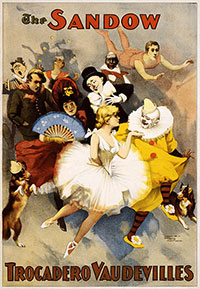
Tin Pan Alley publishing companies not only promoted their sheet music by advertising, but they also focused on a very specific type of promotional strategy: vaudeville performers. Vaudevillea popular form of variety-show theater at the turn of the twentieth century that included singing, dancing, comedy sketches, acrobatics, and skits shows were a popular form of live entertainment at the turn of the twentieth century, featuring hours-long variety shows with singing, dancing, comedy sketches, acrobatics, and skits. Vaudeville was a national network composed of hundreds of venues, and it was dominated by the Orpheum circuit in the western United States and the Keith-Albee theater chain in the eastern United States. Publishing companies often worked out deals with vaudeville singers: in exchange for performing a new tune during the vaudeville show, the performer was guaranteed his picture on the cover, a portion of the profits, or even gifts or bribes. They bribed performers with boxes of fine cigars, bottles of expensive perfume, jewelry, money, telephone numbers of attractive young women, and cases of the best whiskey. Performers such as Al Jolson and Gene Austin were listed as "co-authors" (with royalties) of many songs they knew absolutely nothing about until they saw the sheet music on the streets. Eddie Cantor, Ruth Etting, and many other vaudeville performers openly admitted that they received generous payments for introducing songs into their shows. Rudy Vallee boasted that he built a palatial home in Connecticut with song pluggers’ "gifts." Al Jolson once received a racehorse for plugging a new tune. Clearly, these marketing strategies were successful, because by 1910, Americans were buying 30 million copies of sheet music per year.

"Before the turn of the century, only three American composers made an appreciable dent in the German consciousness: John Philip Sousa, James A. Bland, and Stephen Foster"


