
Overview
As British bands absorbed the sounds of American rock and roll and its predecessors, they also forced American rock bands to reconsider their own sounds and approaches to music. Some artists in the mid-1960s held tight to older ideas and formulas, sometimes with great success. For example, songwriting duo Jerry Leiber and Mike Stoller continued to pen hits during the 1960s, such as “Chapel of Love,” recorded by the Dixie Cups, and “Leader of the Pack,” recorded by the Shangri-Las. At the same time, new types of bands gained popularity in the American market, demonstrating that garage bands, folk rock, and blues revival groups could be a formidable presence on the American record charts.
Objectives
- Identify several artists and types of rock that became popular soon after the British Invasion
- Recall why garage bands, TV rock, the American blues revival, and folk music gained commercial viability in the middle of the 1960s
- Examine how rock music began to diversify following the British Invasion
Garage Bands
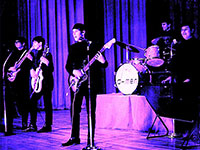
As the Beatles became popular in the United States, teenage boys everywhere sought to copy their music, their looks, and, most likely, their appeal with female listeners. These teenagers usually had more enthusiasm than they had talent, putting together makeshift rock bands with the help of their friends. These garage bands makeshift rock bands put together by friends that usually practice in a basement or garage on cheap or borrowed instruments and recorded on simple, inexpensive equipment earned their name because, more often than not, they practiced their music in a garage or a basement.
Playing on cheap, borrowed, or second-hand instruments, the members of garage bands covered their favorite songs by the Beatles and the Rolling Stones. Once they mastered the songs of their idols, they wrote their own music in the style of the British Invasion groups. Other groups began covering the music of other artists. They recorded on simple, inexpensive equipment and occasionally released their music with the help of local, independent record labels. Garage bands had a notoriously sloppy sound, which was a combination of their amateur musicians’ skills and their low-budget recording equipment. Some bands gained regional popularity through their recordings and live performances, but most simply did not have enough exposure or talent to reach a larger market. A few garage bands did make it to chart hits in the United States, but almost all of these bands were one-hit wondersa group or band that has only one hit song before breaking up or returning to obscurity who were unable to produce a second hit following their initial success.
The quintessential garage band hit was "Louie Louie ♫," which was recorded by the Kingsmen and released in 1963. "Louie Louie ♫" is a cover of a song that had been written and recorded in 1956 by Richard Berry. The members of the Kingsmen recorded this song in a tiny Portland, Oregon studio for only $50. "Louie Louie ♫" is genius in its simplicity: a four-chord pattern repeats endlessly throughout the song, which allows a musician with a limited skill set to master it. The song is in verse-chorus form, and it begins with the chorus instead of with the first verse. A guitar solo appears after the third iteration of the chorus.
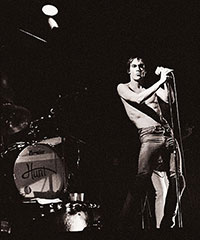
At the end of the guitar solo, singer Jack Ely begins to sing the third verse, but he stops after singing a single syllable. Although Ely’s timing was correct (the guitar solo had lasted the standard length of sixteen measures), he seems to have thought he entered too early, because he begins the third verse again two measures later. True to the garage band aesthetic, the Kingsmen left this mistake in the recording. The lyrics of "Louie Louie ♫" are nearly impossible to understand, but early in 1964, the governor of Indiana claimed that "Louie Louie ♫" contained obscene lyrics and needed to be investigated by the FCC. The FCC’s conclusion: the lyrics of "Louie Louie ♫" were indecipherable.
Following in the wake of the Kingsmen’s success, the American charts were inundated with a rash of one-hit wonders by other garage bands. 1965 and 1966 saw a series of Top 40 hits such as "96 Tears ♫" by ? & The Mysterians, "Land of a Thousand Dances ♫" by Cannibal and the Headhunters, and "Psychotic Reaction ♫" by Count Five. The majority of these garage bands only produced one single that managed to chart, but there were a few exceptions. For example, Sam the Sham and the Pharaohs had six hits between 1965 and 1967, including "Wooly Bully ♫" and "Little Red Riding Hood ♫."



