
Overview
In this lesson, we will consider the genres of hard rock and heavy metal, which emerged in the late 1960s and the early 1970s. The genre of hard rock grew out of the psychedelic rock tradition as well as the British blues revival movement. Like psychedelic rock, it focused on loud, distorted electric guitars. Like the blues, it was riff-based. The “hardness” of hard rock came from an emphasis on the bass guitar as well as on the bass drum. Heavy metal was an important outgrowth of hard rock. Also riff-based, heavy metal tended to have darker themes compared to hard rock.
Objectives
- Identify the defining musical characteristics of hard rock
- Identify the defining musical characteristics of heavy metal
- Identify the important predecessors and early examples hard rock music and musicians
- Identify the defining musical characteristics of Led Zeppelin’s style
- Identify the early examples of heavy metal in the United Kingdom and in the United States
American Heavy Metal
Alice Cooper is one of the key figures in the development of American heavy metal. Born Vincent Furnier, Alice Cooper chose his stage name with the help of a Ouija board, the novelty game that became a symbol of the occult. Both the lead singer and the band were named Alice Cooper, and the band's members included Cooper on vocals and harmonica, Glen Buxton on lead guitar, Michael Bruce on rhythm guitar, Dennis Dunaway on bass guitar, and Neal Smith on drums.
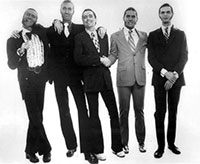
The band's live shows were built around outrageous props, shocking antics, and gender-bending costumes. Cooper himself usually wore leather, heavy makeup, sequined costumes, runny black eyeliner, and studded jackets or gloves. Their shows often ended with the execution of Cooper by the electric chair, guillotine, or noose. Their props included a live boa constrictor, and Cooper would often dismember dolls onstage with an axe. His most notorious moment came during a live 1969 show, when a chicken somehow found its way onstage. Cooper, not realizing that chickens could not fly, tossed the chicken into the audience. Instead of flying away, the chicken plummeted to the ground and was torn apart by the audience members. Rumors abounded that Cooper had bitten the head off a chicken and consumed its blood onstage, which became one of the most persistent legends about Alice Cooper and his stage antics.
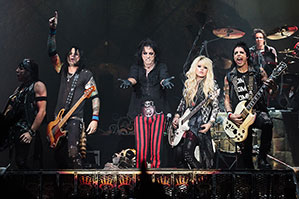
The group's most successful singles during this period were "I'm Eighteen ♫" (1971) and "School's Out for Summer ♫" (1972). Their music was dark, heavy, riff-based, and often had gothic or gruesome messages. Unlike British heavy metal, however, Alice Cooper's music was far more melodic and the lyrics were easier to understand. In addition, riffs were important in the introductions and interludes of the music, but they did not necessarily recur throughout the entire song as they did in British heavy metal. "I'm Eighteen ♫" is clearly rooted in the blues, with its harmonica solo and electric guitar solo.
"School's Out for Summer ♫" also has a bluesy electric guitar riff, but Cooper's vocal delivery is far more aggressive in this song compared to that in "I'm Eighteen ♫." Further, "School's Out for Summer ♫" suggests not a period of respite in the form of summer vacation but rather the utter destruction of the institution: "School's been blown to pieces." As dark as these songs were, they were not odes to the occult or tales of satanic rituals: instead, they were dark versions of issues that faced many of their teenage listeners. For example, "I'm Eighteen ♫" concerns the doubt and insecurity that plagues a person on the cusp of manhood.
In 1975, Cooper began a solo career. His first release as a solo artist was 1975's Welcome to My Nightmare, a concept album. Welcome to My Nightmare is a journey through a child's nightmares. The album's first song, which is also called "Welcome to My Nightmare ♫," mixes elements of the blues, rock, funk, and jazz. Despite the fact that the lyrics describe screaming, sweating, and breakdowns, it sounds like an invitation to an adventure rather than a gruesome tale of horrors.
Cooper continued to record albums and perform live shows well into the 2010s. Cooper's androgynous stage persona, dark stage shows, and dramatic but catchy music established the precedent for many other artists in the late 1970s and 1980s, such as metal band Kiss and glam rocker David Bowie.



