
Overview
Not since the early 1960s and the days of Chubby Checker’s “The Twist” and other dance crazes had rock been considered a music for dancing. By the 1970s, most rock was consumed by listening, not by dancing. That all changed with the rise of disco music, which was for dancing. Disco was a stark contrast to rock music in many ways, such as its embrace of the single and the prominent role played by the DJ and record producer in the creation of a disco record. In this lesson, we will consider many cultural and musical influences on disco in order to examine how and why this dance music was the dominant genre of popular music in the United States by the end of the 1970s.
Objectives
- Identify several musical and cultural predecessors of disco music
- Recall the influence of the gay community and the Stonewall Riots on disco music
- Identify several defining features of the style of disco music
- Examine several significant disco artists and their contributions during the 1970s
Disco Enters the Mainstream
By 1977, disco music was dominating popular mainstream tastes. Saturday Night Fever, a film released in 1977, is widely regarded as the symbol that disco had arrived. Starring John Travolta as a young man who becomes a championship dancer, Saturday Night Fever not only helped disco music as a genre reach mainstream American culture, but it and its soundtrack also made stars out of the Australian pop trio the Bee Gees. The group had three members, brothers Barry, Robin, and Maurice Gibb. The Bee Gees had had modest success in the early 1970s with sentimental songs such as "How Can You Mend a Broken Heart ♫" (1971), but they remade themselves in disco's image. The Bee Gees' disco music from this period featured driving, repetitive rhythms played by studio musicians, and the three members of the group sang in close vocal harmony reminiscent of the Beatles'.
The Saturday Night Fever soundtrack was dominated by the music of the Bee Gees, and the soundtrack was on the Billboard album charts for over three years. Singles such as "Stayin' Alive ♫" epitomized the disco era with their infectious chorus melodies and relentless, driving beats.
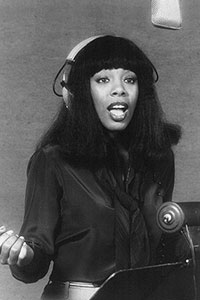
One of the greatest stars of disco music was the singer and songwriter Donna Summer. During the 1970s, Summer charted three consecutive double albums at number 1 in the United States, and she was the first artist to achieve this feat. Summer had experience singing both rhythm and blues and gospel music, and these influences are evident in her soulful, powerful style of singing. Summer was a singer and songwriter in New York and West Germany, often collaborating with the producer Giorgio Moroder. In 1975, she co-wrote the song "Love to Love You Baby ♫" with Pete Bellotte, and Moroder convinced Summer to record the song herself. Moroder created a 12-inch single of "Love to Love You Baby ♫" that was sixteen minutes in length, and a shorter version was sent to radio stations. Filled with erotic moans and groans from Summer, the song became an enormous commercial success despite being banned by the BBC. Its 12-inch single version was a favorite of disco DJs.
With the popularity of "Love to Love You Baby ♫," Summer became the undisputed Queen of Disco. Embraced by both gay and non-gay listeners, she wrote and recorded many songs that combined her powerful singing voice with infections melodies and invigorating dance beats. "I Feel Love ♫" (1977) was one of the first disco singles to use a synthesized orchestra instead of a live orchestra. Electronic music itself was not a new phenomenon, but Moroder's use of a synthesizer to create all of the instrumental sounds in a disco song was new. The use of synthesized backing instruments inspired a number of other disco producers to follow suit, and Moroder's influence would extend to other instrumental dance music genres such as techno.

“Disco was like the celebration of music through dance and my God! When you heard the music sometimes it was like, if you don't get up and dance, you aren't human!”


