
Overview
In the late 1960s and early 1970s, many Americans were listening to psychedelic music, folk rock, funk, and pop. At the same time, a new genre of music was developing in the underground scenes of the United States and the United Kingdom: punk. Punks rebelled against pretentious, over-produced rock stars and the corporations that promoted them. Instead, punk musicians focused on being as anti-corporate as possible. Punk music’s lyrics often emphasize a sense of isolation and alienation from everyday human emotions and issues. The genre of New Wave arose in the late 1970s as the aloof cousin of punk rock. New Wave music maintained a sense of detachment and alienation, but it often included musical language that was more familiar and relatable than that repetitive, distorted, screamed sounds of punk rock. A number of New Wave artists frequently turned to the music of the 1950s and 1960s for inspiration.
Objectives
- Identify several important proto-punk groups and artists
- Recall how and why New York was the center of the emerging punk rock movement
- Recall how the music of punk rock musicians reflects their aesthetic and social values
- Identify the similarities and differences between punk rock and New Wave
- Recall the significance of CBGB in the early careers of New Wave bands such as Talking Heads and Blondie
- Examine the role of earlier styles of rock and popular music in the recordings of groups such as the B52s and the Cars
New Wave at CBGB
New York's CBGB had been the center for a number of punk bands during the 1970s, including Television and the Ramones. Later in the decade, other groups who performed regularly at CBGB became some of the first commercially successful new wave bands.
Like Devo, the members of Talking Heads were also art students. Songwriter, singer, and guitarist David Byrne, guitarist Jerry Harrison, bassist and vocalist Tina Weymouth, and drummer Christ Frantz met when they were students at the Rhode Island School of Design in the 1970s.
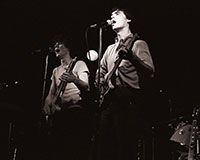
The group's name came from the group's observation that television rarely showed a person's entire body; instead, television focused on the head, and the head was usually talking. The group began performing at CBGB as the opening act for the Ramones. The members of Talking Heads did not wear the ripped jeans, safety pins, and leather jackets of the punk bands; they sported the sweaters and khakis of college art students. Music critics, college students, and artists were drawn to the music and style of Talking Heads, perhaps because they were so unlike the Ramones and other groups in the CBGB scene at the time.
Talking Heads were soon signed by Sire Records, and they released their first album, Talking Heads: 77, in 1977. The song "Psycho Killer ♫" from Talking Heads: 77 is typical of the group's musical style of the time. Written by Byrne, Frantz, and Weymouth, "Psycho Killer ♫" has a repetitive beat in the drums and a straightforward bass line that Weymouth plays throughout the song. The rest of the instruments are relatively spares, repetitive, and straightforward. The lyrics of the song mix French, English, and disarticulated and repeated syllables. The lyrics narrate the inner monologue of a serial killer. For the most part, Byrne's singing is restrained and monotonous, although at times he lets loose and sings in a higher range. Talking Heads: 77 and the Talking Heads' next several albums earned critical acclaim from those who praised the group's artsy, intellectual songs.
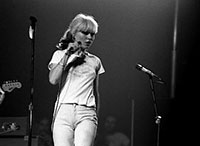
Another successful New Wave group that started at CBGB was Blondie. Founded by singer Deborah Harry and guitarist Chris Stein, Blondie's early albums such as Blondie (1976) and Plastic Letters (1978) were far more successful in England than in the United States. Although the group is classified as New Wave, their music was more stylistically eclectic than that of their New Wave contemporaries. Harry's singing style was less monotonous and more expressive when compared to other New Wave lead singers.
Blondie's breakthrough came with their third album, Parallel Lines (1978). Parallel Lines featured "Heart of Glass ♫," which was Blondie's first major hit single. "Heart of Glass ♫" has a sound that was strongly influenced by disco, including a disco beat with emphasis on the hi-hat. Yet, "Heart of Glass ♫" still has many characteristics of New Wave, including synthesized instrumental sounds, abstract sound effects, and detached lyrics. Instead of an impassioned declaration of lost love, Harry sings, "Once I had a love and it was a gas / soon turned out to be a pain in the ass." At a time when there was a massive chasm between disco and rock, Blondie's experiment with disco sounds proved a successful bridge between the two styles. Of course, some purists accused Blondie of "selling out" by incorporating disco elements into "Heart of Glass ♫," but eclectic musical styles were an important part of Blondie's music.


“The whole punk scene is, of course, responsible for the Go-Go's ever getting created. Because before punk rock happened, you couldn't start a band if you didn't know how to play an instrument. But when punk happened it was like, 'Oh, it doesn't matter if you can play or not. Go ahead, make a band.' And that's exactly what the Go-Go's did.”

