
Overview
As the term “disco” lost favor in the late 1970s and early 1980s, different types of dance music continued to develop and be played in clubs in the Midwest, especially in Chicago and Detroit. The first important genre of dance music to develop during this period was Chicago house, and this music strongly influenced musicians in the nearby city of Detroit. Young African American musicians from Detroit would travel to Chicago every weekend to hear house music, and they began creating their own style of and approach to electronic dance music at home. This genre of music came to be called techno. Musicians created techno with electronic instruments such as synthesizers, computers, samplers, drum machines, and multi-track mixers.
Objectives
- Recall several important technological developments and instruments from the late 1970s and early 1980s
- Identify the musical predecessors of Detroit techno music
- Recall the musical and socioeconomic factors that led to the development of Detroit techno
- Examine the development and dissemination of techno into the 1990s
Roots of Techno
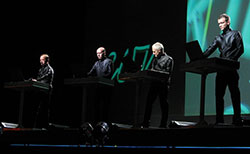
Techno grew out of several different musical traditions. Like disco, techno prioritized the role of the DJ over the role of instrumental musicians. The disco DJ was responsible for playing recorded music and combining existing records in new and interesting ways in order to keep people dancing in clubs.
Techno also draws from other types of popular music that featured synthesizers almost exclusively.
Groups such as the Eurythmics and New Order, as well as producers such as Giorgio Moroder (who produced a number of Donna Summer's songs) prominently featured synthesized sounds. In the early 1980s, the sounds of so-called "synth-pop" (that is, popular music created almost entirely on synthesizers) were ubiquitous in popular music. In many cases, these recordings rarely featured non-electric instruments.
Another important predecessor of and influence on techno was the so-called Krautrockan important predecessor to techno popularized by the German band Kraftwerk; mixed the instrumental sounds of rock music with electronic sounds and textures popularized by the German band Kraftwerk. Krautrock typically mixed the instrumental sounds of rock music instrumentation with electronic sounds and textures. The members of Kraftwerk wrote, performed, and produced almost all of their own music. They used electronic instruments such as the Minimoog synthesizer and other synthesizers and keyboards. The lyrics on their songs were delivered through a vocoder or rendered using a text-to-speech software program. Their music was self-consciously mechanical and abstract, yet it was infectious on the dance floor. Albums such as Trans-Europe Express (1977) and The Man-Machine (1987) featured danceable tunes that were created almost exclusively with electronic instruments and synthesizers. The single "Trans-Europe Express ♫" (1977) is typical of Kraftwerk's style, with its completely synthesized soundscape and themes of technology and transportation in the vocoded lyrics.

"The spirit of house music, electronic music, in the beginning was to break the rules, to do things in many different ways."


