
Overview
By the late 1980s and early 1990s, hip-hop had become increasingly diverse in its sounds, styles, and messages. In this lesson, we will survey several major styles of hip-hop that were popular at the end of the 1980s, including political hip-hop, pop rap, gangsta rap, and sample-based hip-hop. By this time, hip-hop ran the gamut from family-friendly pop rappers such as MC Hammer to the hard, streetwise tales spun by the members of N.W.A.
Objectives
- Identify the characteristics of several styles and subgenres of hip-hop from the late 1980s and early 1990s, including political hip-hop, sample-based hip-hop, gangsta rap, and pop rap
- Recall the significance of sampling in the music of groups such as De La Soul, the Beastie Boys, and Public Enemy
- Recall why some pop rap artists such as MC Hammer were accused of “selling out” when their music had crossover appeal
Pop Rap
At the same time that N.W.A. was rapping about life in Compton and Public Enemy was encouraging its listeners to "fight the power," a style of pop-oriented rap was becoming popular with mainstream audiences. Rapper the Fresh Prince (Will Smith) and DJ Jazzy Jeff recorded songs that were far less explicit and controversial compared to those of gangsta rap or political rap groups. In their first single, "Girls Ain't Nothing but Trouble ♫" (1986), DJ Jazzy Jeff sampled the theme from the television show I Dream of Jeannie while Smith delivered an amusing tale of misadventure that lacked any profanity. The duo's single "Parents Just Don't Understand ♫" (1988) was another humorous tale of Smith attempting to evade capture by his parents, and the music video was played ceaselessly on MTV.
The music of DJ Jazzy Jeff and the Fresh Prince was benign, catchy, and non-violent, and it had enormous crossover appeal with white audiences and with pop listeners. In 1990, Will Smith was cast as the lead character on the television show The Fresh Prince of Bel-Air, and he has acted in dozens of films. He has continued to record commercially successful rap albums and is one of the top-paid movie stars in Hollywood.
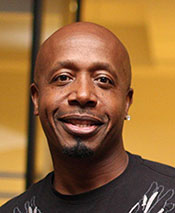
Another rapper who achieved significant crossover appeal with pop listeners was MC Hammer. MC Hammer was the first rap artists whose album sold over ten million copies. His debut album Please Hammer, Don't Hurt ‘Em (1990) and its lead single "U Can't Touch This ♫" were more dance-oriented than other hip-hop recordings of the time. MC Hammer's music had catchy hooks, often sampled from other popular songs. For example, "U Can't Touch This ♫" generously samples Rick James's funk hit "Super Freak ♫" (1981). The lyrics were straightforward and repetitive, and the music videos and MC Hammer's live performances focused heavily on energetic and well-coordinated dancing.
Please Hammer, Don't Hurt ‘Em was the first hip-hop album to reach number 1 on the pop charts (other groups had crossed over before, but MC Hammer was the first to reach number 1). His dance moves, iconic style (the so-called "Hammer pants"), and catchy music made him an ideal figure for commercial endorsement. MC Hammer's music and image were quickly capitalized on with the creation of an MC Hammer doll and an animated Saturday morning program called Hammerman that featured his likeness. During his career, MC Hammer was frequently accused of "selling out" because his music had such enormous popular appeal with white audiences and with pop audiences. However, rapper Ice-T defended MC Hammer, claiming that the label "sellout" should only be applied to musicians who changed their styles in order to sell more records; to Ice-T, MC Hammer had remained true to his own musical style throughout his career, which happened to be a pop-oriented style of rap.


"N.W.A were the audio-documentarians of their time. They were trying to shock people with the violence of their language and the subjects they were talking about. The fact that they dressed in guerilla outfits like the Black Panthers made them shocking by their appearance as well."

