
Overview
In the late 1980s and early 1990s, many rock musicians wrote and recorded music that was closely aligned with rock genres and styles of the past. Britpop bands echoed the music of the British Invasion. Industrial rock artists took the darkness of heavy metal and combined it with the abstraction of the Velvet Underground. Pop punk bands recorded and released music that was the most commercially successful music by any punk rock artist in history. At the same time that these and other bands were absorbing and redefining rock traditions, listeners were engaging with new forms of listening technology in the forms of CDs and MP3s.
Objectives
- Recall the changes that occurred in commercial recording technology during the 1980s and 1990s
- Recall the important people and stylistic features of Britpop, industrial rock, and pop punk
- Examine how Britpop, industrial rock, and pop punk music related to earlier styles and genres of rock music
Pop Punk
The 1990s saw the emergence of a style of punk music commonly called pop punka style of punk music that punk is inspired by the music of earlier punk bands such as the Ramones and the Sex Pistols in its speed, aggression, and themes of anarchy or non-conformity, but it is also more melodic; examples include Green Day and Blink-182. Pop punk is inspired by the music of earlier punk bands such as the Ramones and the Sex Pistols in its speed, aggression, and themes of anarchy or non-conformity, but it is also more melodic. One of the most respected and long-lived pop punk bands was the trio Green Day, whose members include singer and guitarist Billie Joe Armstrong, bassist Mike Dirnt, and drummer Tré Cool. The group formed in Oakland, California in the late 1980s, and they built a strong local following playing at the Oakland club 924 Gilman Street and released two albums on the independent label Lookout! Records.
Their breakthrough came in 1994, when they signed with the major label Reprise Records and released the album Dookie.The spirit of punk rock permeates the album: the title is a slang term for feces, the album cover shows bombs being dropped on a stage, and the music is fast, catchy, and compact.
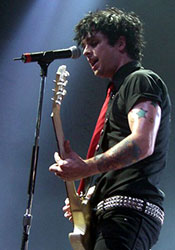
Most of the songs were written by Armstrong, and they focused on topics familiar to punk rock as well as to more mainstream pop, including anxiety and depression, divorce, murder, love and relationships, and boredom. The album's second single, "Welcome to Paradise ♫," had appeared on an earlier album called Kerplunk!, but the band re-recorded it for Dookie. The members of Green Day wrote the song about their experiences leaving their parents' homes and moving into a warehouse in West Oakland. The warehouse attracted artists and musicians as well as homeless people and drug addicts who needed a place to live rent-free. The song is at times ironic and sincere about the new "paradise" the members of the group inhabit.
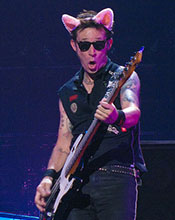
Critics and historians credit Green Day as the first punk band to make a major commercial breakthrough into the mainstream. Although bands such as the Sex Pistols and the Ramones sold respectable numbers of albums during the 1970s, Green Day was one of the first punk bands to sell over a million copies of an album within a year of its release. Dookie had sold over twenty million copies since its release in 1994. Like other bands that tried to balance a disdain for commercialism with their own commercial success, Green Day was shunned by some of its early followers. The 924 Gilman Street club refused to allow the members of Green Day to enter once they had signed with a major label, calling them sellouts.
Green Day released several more albums during the 1990s, although their popularity had faded significantly by 2000.
In 2004, Green Day released American Idiot, a concept album about a character named Jesus of Suburbia. In many of the album's songs, the band broke from traditional song forms such as simple verse and verse-chorus. American Idiot sold millions of copies and revived Green Day's career. An American Idiot stage musical based on the album premiered in 2009.


“In the '90s, the radio was still alive with all different kinds of points of view, and I think that's why people are longing for that time. It was the first time that alternative music broke through to the mainstream.”

