
Overview
Music is an ever changing expression of the time, place, and people who create it. In the border areas of Mexico and the U.S. and in Mexican-American populations around the country, unique musical forms and styles have been developed to entertain, educate and uplift audiences. In this chapter we will discuss the genre of conjunto in its traditional and modern forms in Texas. These musical styles appeal to the working class and function in large part to accompany couple dancing. Forms will include the popular polka dance, the corrido (a type of narrative ballad) and the ranchera, (a popular type of Mexican song). The development of the traditional conjunto ensemble will be traced from the early 1900s through the 1960s. Examples are given of innovative hybrid musical styles formed in combination with mainstream popular music and Latin American music of recent years. Most of the music is sung in Spanish with the exception of some cross-over English songs.
Objectives
- Identify the ensembles and selected genres and forms of Conjunto aurally
- Recall the bajo sexto and accordion and their musical roles and functions
- Identify the following song/dance forms: polka, corrido, ranchera, cumbia
- Recognize the major artists of Conjunto music
- Analyze the cultural context that these ensembles, genres, and forms originate from as part of an ongoing, bi-cultural musical expression
Introduction
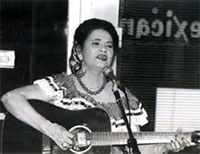
Music is an ever changing expression of the time, place, and people who create it. In the border areas of Mexico and the U.S. and in Mexican-American populations around the country, unique musical forms and styles have been developed to entertain, educate, and uplift audiences. In this chapter we will discuss the genre of Conjunto in its traditional and modern forms in Texas. These musical styles appeal to the working class and function in large part to accompany couple dancing.
Forms include the popular polka dance and the corrido, a type of narrative ballad which has served as a cultural mediator, to document historical events, and to glorify cultural heroes, as exemplified by the song "Gregorio Cortez ♫." Music of la raza, or the people, is found in the ranchera, a popular type of Mexican song which romanticizes the ranch way of life and addresses the joys and sorrows of love relationships. Lydia Mendoza's ranchera, "Mal Hombre (Bad Man) ♫," shows a womanist perspective, and it was her favorite type of song to perform. The traditional conjunto ensemble consists only of the bajo sexto (a 12-string guitar) and button accordion, exemplified by Narciso Martinez's "La Chicharronera." By the 1950s, the ensemble had expanded to include drum set and electric bass with electric bajo sexto and accordion, to form the standard grouping. Artists influential in this development are Valerio Longoria, Tony de la Rosa, and Conjunto Bernal. Contemporary Conjunto music has hybridized with many forms of mainstream popular music including jazz, rhythm and blues, rap, country, and Latin styles such as the cumbia. Most of the music is sung in Spanish with the exception of some cross-over English songs.

"slow, dogged struggle against economic enslavement and the loss of their own identity was the most important factor in the development of a distinct local balladry."


