
Overview
Music is an ever changing expression of the time, place, and people who create it. In the border areas of Mexico and the U.S. and in Mexican-American populations around the country, unique musical forms and styles have been developed to entertain, educate and uplift audiences. In this chapter we will discuss the genre of conjunto in its traditional and modern forms in Texas. These musical styles appeal to the working class and function in large part to accompany couple dancing. Forms will include the popular polka dance, the corrido (a type of narrative ballad) and the ranchera, (a popular type of Mexican song). The development of the traditional conjunto ensemble will be traced from the early 1900s through the 1960s. Examples are given of innovative hybrid musical styles formed in combination with mainstream popular music and Latin American music of recent years. Most of the music is sung in Spanish with the exception of some cross-over English songs.
Objectives
- Identify the ensembles and selected genres and forms of Conjunto aurally
- Recall the bajo sexto and accordion and their musical roles and functions
- Identify the following song/dance forms: polka, corrido, ranchera, cumbia
- Recognize the major artists of Conjunto music
- Analyze the cultural context that these ensembles, genres, and forms originate from as part of an ongoing, bi-cultural musical expression
Lydia Mendoza (1916-2007)
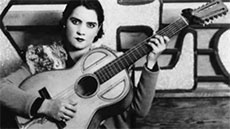
Lydia Mendoza was born in Houston, Texas in 1916. She learned guitar from her mother at age seven and became a raza recording artist at age twelve. She rose to fame in 1934 with Mal Hombre ♫ sung in ranchera style. This is her most famous song, a stinging social commentary on the unfair treatment of women. From this point on, Lydia included womanist perspectives in her work.
This song was a big hit in Spanish speaking America of the 1930s and the emotional tone of the song parallels the blues being sung by black women of the same time period. Lydia began her career as a wandering, street musician, and thus knew by memory many rancheras, corridos, huapangos, boleros, tangoscouple dance from Argentina, in which one dance rhythm is the habanera rhythm (slow, dotted) consisting of a long-short, long, long rhythmic pattern, milongas, and pasodobles. She established herself first in remote migrant agricultural communities throughout Texas and then moved northward to Michigan. Ranchera was her most loved genre and when she performed, accompanying herself on the bajo sexto, she embodied the persona of a country person by designing and sewing her own highly stylized Mexican dresses. She was one of la raza and devoted her life to singing about them and for them.
Important contributions and interesting facts:
- Lydia learned song lyrics as a youngster from printed candy wrappers
- Her nickname was "La Alondra de la Frontera" or "The Lark of the Border"
- In 1982, she became the first Texan to receive the National Heritage Fellowship lifetime achievement award from the National Endowment for the Arts
- She recorded with Okeh and Bluebird Records in the late 1920s and early 1930s
- Noted for her strong, earthy voice and proficiency on the bajo sexto

"They have been sung at home, on horseback, in town plazas by traveling troubadours, in cantinas by blind guitarreros (guitarists), on campaigns during the Mexican Revolution (1910–30), and on migrant workers' journeys north to the fields."


