
Overview
Music is an ever changing expression of the time, place, and people who create it. In the border areas of Mexico and the U.S. and in Mexican-American populations around the country, unique musical forms and styles have been developed to entertain, educate and uplift audiences. In this chapter we will discuss the genre of conjunto in its traditional and modern forms in Texas. These musical styles appeal to the working class and function in large part to accompany couple dancing. Forms will include the popular polka dance, the corrido (a type of narrative ballad) and the ranchera, (a popular type of Mexican song). The development of the traditional conjunto ensemble will be traced from the early 1900s through the 1960s. Examples are given of innovative hybrid musical styles formed in combination with mainstream popular music and Latin American music of recent years. Most of the music is sung in Spanish with the exception of some cross-over English songs.
Objectives
- Identify the ensembles and selected genres and forms of Conjunto aurally
- Recall the bajo sexto and accordion and their musical roles and functions
- Identify the following song/dance forms: polka, corrido, ranchera, cumbia
- Recognize the major artists of Conjunto music
- Analyze the cultural context that these ensembles, genres, and forms originate from as part of an ongoing, bi-cultural musical expression
1950s Conjunto
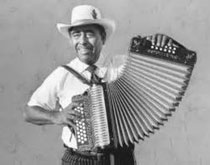
Valerio Longoria
Valerio Longoria was an innovative accordionist. He was born in 1924 in Kenedy, Texas, north of Corpus Christi. As a child he accompanied his father on migrant treks throughout the southern United States and had little schooling as a result. His first paying accordion gig at age eight brought in $3. After serving in the military during World War II, he resumed performing and was recruited by Corona Records of San Antonio. He recorded his first pieces in 1947 and moved to Ideal Records in 1949, where his fee was raised from $15 to $20 per record. Valerio moved north to Chicago for a period of time while continuing to record and later moved to Los Angeles. He returned to San Antonio, Texas in his final years and lived there until his death, performing and teaching accordion at the Guadalupe Cultural Arts Center.
Important contributions and interesting facts:
- One of the first musicians to combine vocals with the instrumental conjunto
- He altered the accordion to enable transposition to more than two keys
- Valerio popularized the ranchera in vals (waltz) tempo, and replaced the accordion melody line with a duet style vocal line sung in thirds
- He was the first to record and regularly perform the bolero and make it a standard song in the conjunto repertoire
- Made regular use of the dance band drums (drum set or trap set) in the conjunto starting in 1948, though they were not considered a standard until the 1950s


"They have been sung at home, on horseback, in town plazas by traveling troubadours, in cantinas by blind guitarreros (guitarists), on campaigns during the Mexican Revolution (1910–30), and on migrant workers' journeys north to the fields."

