
Overview
The music of contemporary Mexican American culture ranges in style from traditional Mexican styles such as norteño and mariachi, to hybrid forms that combine the polka/ranchera sound with country, rock and roll, and cumbia, to hip hop and rap styles. Often the term Tejano is used generally to indicate any of these styles that have developed in Texas. However, for our purposes, the term Tejano will be used more specifically to indicate a modern, expanded conjunto style (electrified bajo sexto, bass, accordion, drumset, synthesizer and additional instruments). Individual artists and bands from California, Arizona, and Texas have driven the innovation of new approaches to traditional music with a resultant diversity of material. The selected artists and genres in this chapter will include Little Joe y la Familia, Jimmy Gonzalez y Mazz, David Lee Garza y los Musicales, Patsy Torres, Linda Ronstadt, Los Lobos, and Selena.
Objectives
- Identify the instrumental ensembles and musical styles of La Onda Chicana, Mariachi, Tejano, Rock and Tejano/Cumbia aurally
- Recall the contributions and innovations of selected artists to Mexican American popular music
- Identify the following song/dance forms: polka, cumbia, son jarocho, son jalisciense
- Examine the cultural context that these ensembles, genres and forms originate from and understand them as part of an ongoing, bi-cultural musical expression
Son jalisciense (Song from Jalisco)
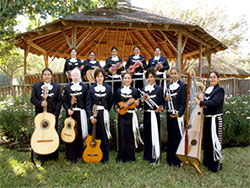
The most typical type of song/dance form heard in mariachi music is the son jalisciensesong from Jalisco; a regional Mexican song style from the state of Jalisco characterized by the alternation of 3/4 and 6/8 meter , the cousin of the son jarocho and originally from Cuba. Meaning "song from Jalisco," the typical dance rhythm alternates between triple and duple (3/4 and 6/8) with rhythmic drive appropriate for dancing. Versos (verses) alternate with instrumental interludes, similar to the son jarocho. Other forms performed by mariachi bands include the cancion rancheramariachi song genre in 2/4 meter, bolero rancheramariachi song genre in 4/4 meter and huapangoMexican dance genre that is characterized by a complex rhythmic structure mixing duple and triple meters which reflect the intricate steps of the accompanying dance and the jarabea “string,” or medley of four or more. The latter is a string, or medley of four or more sones, the most famous of which is the Mexican Hat Dance or jarabe tapatio.
Mariachi in America
During the late 1950s into the 1960s, organized mariachi groups from Mexico City immigrated to Los Angeles, bringing the full-fledged Mexican style across the border. In 1961, Nati Cano organized his group Los Comperos which helped to popularize the style amongst non-Hispanics in L.A. He also opened the La Fonda restaurant in 1969 which presented the first showcases, or stage performances of mariachi in the country. This was in high contrast to the more common type of restaurant performance as strolling musicians. Mariachi Cobre (from Tucson, AZ) became the first prominent professional Mexican American mariachi through its long career at Disney World in Florida. The first mariachi educational conference and festival was held in San Antonio, Texas in 1979, presaging many more festivals and conferences to be held around the southwest (in New Mexico, Arizona and California). Today, in many public schools in the southwest, mariachi ensembles are considered to be core ensembles, on a par with choir, orchestra and band, and taught from elementary through high school levels. As generations of children continue to hear mariachi played in their homes and participate in school ensembles, the character and vitality of the music will remain.



