
Learning Objectives
Be ready to...
- Relate how the performer acts as a bridge between the composer and the listener.
- Relate how the performer conveys the composer's intent by using their own individual style and emotional approach to the printed score.
- Discuss the role of the performer by listening to and discussing the interpretation of a spiritual.
- Define the following musical terms: composer, notation, performer, score, spiritual, technique.
The Performer's Role
In his own words...
"Since a musician cannot otherwise move people, but he be moved himself, so he must necessarily be able to induce in himself all those affects which he would arouse in his auditors; he conveys his feelings to them, and thus most readily moves them to sympathetic emotions."
Carl Philipp Emanuel Bach
Music and time are inextricably intertwined. Whether in a live or recorded performance, music is an art form that occurs “in the moment.” From the composer or the performer's point of view, music may happen without it actually being performed, such as when the composer thinks of a tune “in her head” or when the performer imagines the music without actually playing it. As far as the listener is concerned, however, music only happens when it is actually performed.
As opposed to numerous world music traditions where there is no distinction between composer and performer,[1] in European Western music from around the 1800s onward, the performer acts as the bridge between the composer and the listener by interpreting the composer’s musical score and conveying the composer's intent during the performance. The performer adds individual style and emotional approach to the interpretation of the printed score—musical notation—which may be written for either a solo performer or a group of musicians (referred to as a vocal or instrumental ensemble).
The way we perceive or respond to a piece of music is unavoidably tied to the way it is performed. The listener is more likely to feel moved by or connected to the music if the performer not only has great technique as a singer or instrumentalist, but also manages to communicate a deep understanding of the emotional message or mood of the music. The role of the performer is one of the most integral and influential aspects of a music experience.
Interpretation
The term interpretation refers to how a performer chooses to communicate the artistry of the music to the audience. In every aspect of the performance, a performer makes choices on how to present the musical material. A performer may give extra weight to a particular passage by playing or singing more softly or more loudly; more quickly or more deliberately; with more control or more abandon; by letting a note linger; or even by using silence, among many available techniques. When a performer conveys an authentic interpretation, one in which it seems like the person is truly experiencing, appreciating, and understanding the music, we often say that the individual is performing “from the heart.”
Listen carefully to the well-known spiritual "Deep River" as interpreted by Barbara Conrad. What, if anything, do you feel as you listen to Ms. Conrad sing this song? What kinds of messages, emotions, images, memories, and/or thoughts does she manage to convey?
Composer: Anonymous
-
"Deep River"
0:00 - 0:47
Deep river,
My home is over Jordan,
Deep river, Lord,
I want to cross over into camp ground
Composer: Anonymous
-
"Deep River" [ 00:00-00:47 ]00:47
0:47 - 1:29
Deep river,
My home is over Jordan,
Deep river, Lord,
I want to cross over into camp ground
Composer: Anonymous
-
"Deep River" [ 00:47-01:29 ]00:42
1:29 - 2:02
Oh, don't you want to go
To that Gospel feast
That promised land
Where all is peace?
Composer: Anonymous
-
"Deep River" [ 01:29-02:02 ]00:33
2:02 - 2:35
Oh, Deep river,
My home is over Jordan,
Deep river, Lord,
I want to cross over into camp ground
Composer: Anonymous
-
"Deep River" [ 02:02-02:35 ]00:33
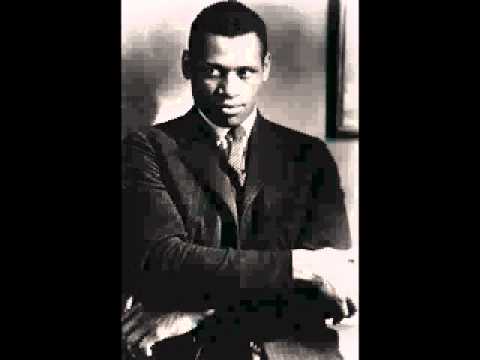
Paul Robeson sings Deep River
Now listen to a different interpretation of the same spiritual, as sung by Paul Robeson. As you listen, ask yourself the same questions, but also think about the differences, if any, that you hear between the two versions.
Focusing on the second and third lines of the song ("My home is over Jordan/Deep river"), does one performer sing this passage more loudly or softly than the other? More quickly or slowly? Does one or the other performer let the notes linger by drawing out the words? What impact do these variations in interpretation have on you as a listener?
Generally speaking, there are no right or wrong interpretations of a piece of music. An interpretation you find delightful or moving may leave another listener cold, and vice versa; it often comes down to a matter of personal preference. However, a skilled listener is able to identify the differences of interpretation that distinguish one performance from another.
In his own words...
"The plantation songs known as the Spirituals are the spontaneous outbursts of intense religious fervor...They breathe a child-like faith in a personal Father, and glow with the hope that the children of bondage will ultimately pass out of the wilderness of slavery into the land of freedom..."
Booker T. Washington - 1904
Types of Performers
Performers of music are typically referred to by the instrument they play. A musician whose instrument is the oboe is known as an oboist; the cello, a cellist; the voice, a vocalist (or singer); and so on.
Performers may also play singly or in groups. The most basic distinction is between solo and ensemble performers. The term solo (from the Italian solo, meaning alone) takes on different meanings depending on the musical context. It may refer to a piece of music interpreted by one performer alone, but more often than not, it denotes a section or sections of the music where one performer temporarily takes precedence over the rest. Either way, such a performer is also known as a soloist.
Solo Vocalist
Composer: Hildegard von Bingen
-
"Alleluia, O virga mediatrix"
Solo Vocalist
Composer: Gioachino Rossini
-
"The Barber of Seville: Una Voce Poco Fa"
Solo Pianist
Composer: Arnold Schoenberg
-
"Six Little Piano Pieces, Op. 19: II. Langsam"
Solo Tumpeter
Composer: Duke Ellington
-
"Searchin'"
First used around 1844, the term ensemble—from the French word ensemble meaning “all the parts of a thing considered together”—refers to groups of musicians playing together as a unit. Music ensembles can be of any size—within practical limits, of course. Ensembles are often referred to based on the number of performers that make up the group. For example, a group of two musicians is known as a duo; a group of three, a trio; four, a quartet; and so on. The largest music ensemble is arguably the traditional symphony orchestra, which can typically gather over 100 instrumentalists. The Guinness world record for the biggest orchestra currently stands at 8,097 musicians, and was achieved by Gazprom's Fund for Supporting Social Initiatives (Russia), in Saint Petersburg, Russia, on 1 September 2019.
Vocal Ensemble
Composer: Perotin
-
"Sederunt principes (4-part Organum - Plainchant)"
Vocal Ensemble
Composer: Ralph Vaughan Williams
-
"Come Down, O Love Divine"
Instrumental Ensemble
Composer: Wolfgang Amadeus Mozart
-
"Oboe Quartet in F Major, K. 370: II. Adagio"