
Learning Objectives
- Explain how the Classical period (1750-1825) characteristics of order, objectivity, and harmonious proportion relate to the music characteristics of the period.
- Summarize how the American Revolution (1775-83) and the French Revolution (1789-99) profoundly changed political systems and social order.
- Classify the large-scale musical forms in which the Classical masters composed.
- Explain music making in the context of the royal court and the patronage system.
- Define form and absolute music, and relate these concepts to one another.
- Differentiate between the main musical forms of the Clasical-era by summarizing the development of the symphony, sonata, string quartet, and the concerto.
- Define and analyze the symphony, sonata, string quartet, and concerto forms in the context of the Classical period.
- Describe the impact of the major Classical composers Haydn, Mozart, and Beethoven.
- Discuss the impact of Beethoven's thirty-two piano sonatas.
- Compare and contrast the two types of Italian opera: opera buffa and opera seria.
Classical Period (1750-1825)
Ludwig van Beethoven
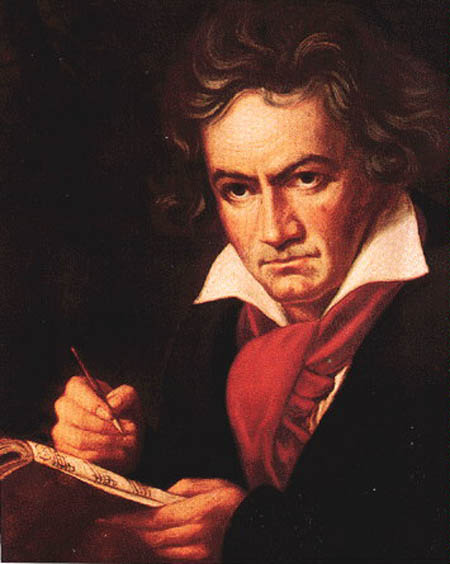
Leonard Bernstein on Beethoven:
"Many, many composers have been able to write heavenly tunes and respectable fugues. Some composers can orchestrate the C-major scale so that it sounds like a masterpiece, or fool with notes so that a harmonic novelty is achieved. But this is all mere dust—nothing compared to the magic ingredient sought by them all: the inexplicable ability to know what the next note has to be. Beethoven had this gift in a degree that leaves them all panting in the rear guard."
Beethoven broke all the rules, and turned out pieces of breath-taking rightness. Rightness—that's the word! When you get the feeling that whatever note succeeds the last is the only possible note that can rightly happen at that instant, in that context, then chances are you're listening to Beethoven. Melodies, fugues, rhythms—leave them to the Tchaikovskys and Hindemiths and Ravels. Our boy has the real goods, the stuff from Heaven, the power to make you feel at the finish: Something is right in the world. There is something that checks throughout, that follows its own law consistently: something we can trust, that will never let us down..."
Composer: Ludwig van Beethoven
-
"Symphony No. 3 in E-Flat Major, Op. 55 "
Beethoven's Life

Beethoven was born in Bonn on December 17, 1770. At the time, Germany was not a unified country but rather a loose grouping of some 250 states, each of which had its own laws, army, taxes, and to a large extent, customs. Beethoven came from a musical family. His father, an alcoholic tyrant prone to bouts of violence, was a singer in the chapel of the Archbishop, the Elector of Cologne. He was also a rather unimpressive piano and violin teacher. Beethoven's mother was a cook in the summer palace where his father worked. His grandfather, also named Ludwig, was a trained musician who had been elected the Archbishop's Kapellmeister in 1773.
Beethoven developed his knowledge and skill of music very quickly. In 1787 (at the age of 17), he traveled to Vienna to meet Mozart, who, apparently impressed by his improvisation skills, allegedly said, “Watch this young man; he will give the world something worth listening to.” This article gives some interesting insights on the relationship between the two composers.
Joseph Haydn, sometimes called "Father of the Symphony," was arguably the figure that had the greatest influence on Beethoven's early development as a composer. Their first meeting took place in Bonn, when Beethoven had just turned 20 and Haydn was on his way to perform in London, where he had dominated the concert scene after the death of Johann Christian Bach—the "London Bach"—in 1782. They met again in 1792, on Haydn's return journey. On that occasion, Haydn was so impressed by Beethoven's talent that he invited him to come to Vienna and become his pupil. Thus, Haydn became not only the most famous of other teachers, Antonio Salieri among them, that Beethoven had from 1792 to 1795—often in secret so as not to offend Haydn—but the catalyst of Beethoven's move to the city where he quickly gained a reputation as a remarkable keyboard player and composer of great originality.
Beethoven didn't take too well Haydn's request to write the phrase "Pupil of Haydn" in the title page of his Op. 1 Trios, or his criticism, after hearing them performed in 1795, that the third one needed more work before it could be published. Apparently, Beethoven never forgot the request or the criticism. The fact that Haydn was such a towering figure in the European music scene at the time did not prevent him from saying that "although he had some instruction from Haydn, he had never learned anything from him." Nevertheless, Beethoven's admiration for Haydn's work was immense. According to one of his biographers, he referred to the old master "in terms of reverence, regarding him as the equal of Mozart and Bach." Relations were not strained enough by the Piano Trio incident to prevent Beethoven from dedicating his next opus—the set of three Piano Sonatas, opus 2—to Haydn. The two remained in good terms until Haydn's death in 1809.
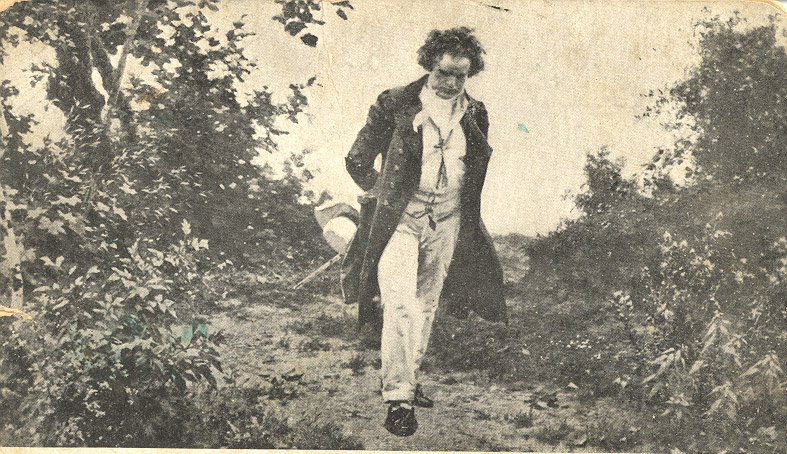
Beethoven's hearing loss began when he was still a young man. By 1815, his increasing deafness made public performance as a pianist or conductor impossible. He was already considered rather eccentric and difficult to get along with; his mounting deafness only made matters worse. By 1817, Beethoven had gone completely deaf. During the last three years of his life, he devoted himself to writing a series of string quartets considered by many to be among his greatest works, although they arguably remain the most difficult to listen to and understand of his compositions. By the end of his life, he was composing in a personal style unlike anything previously heard until the 20th-century string quartets of Béla Bartók.
Beethoven did much to increase and extend the existing music genres. His incorporation of a chorus into the symphonic form through his Ninth Symphony No. 9, the addition of more instruments and different instruments into the standard orchestra ensemble, and the augmentation of the traditional forms through increased length, number of movements, and intricacy of harmony widened the horizons and conceptual ideas for later generations of composers. To his contemporaries, he was sometimes a controversial figure, making heavy demands on listeners both by the length and complexity of his writing as he explored new fields of music.
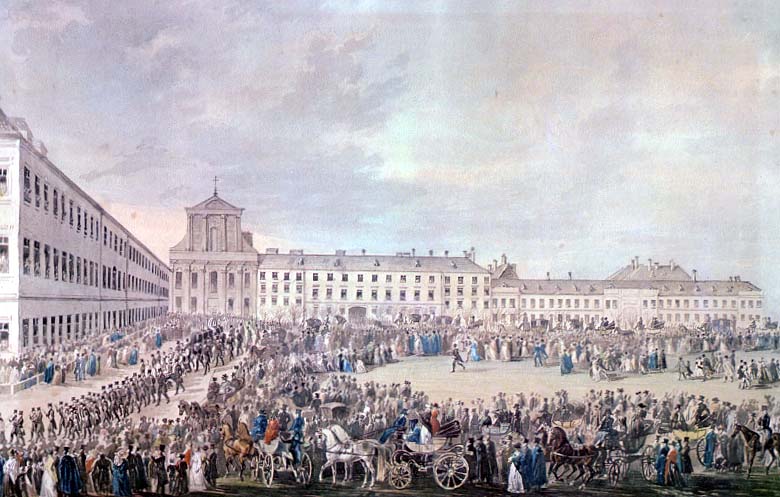
Beethoven died on March 26, 1827. His death is surrounded by myth. According to one report, his last words were “I shall hear in heaven.” Some 20,000 people attended his majestic funeral.