
Learning Objectives
- Relate how Romantic poets and artists abandoned traditional subjects, turning instead to the passionate and the fanciful.
- Relate how the Industrial Revolution impacted the technological development and affordability of musical instruments.
- Analyze how the orchestra grew in size and sound as new instruments were introduced and composers demanded greater levels of expression.
- Illustrate how Romantic composers explored nationalistic folklore and exotic subjects.
- Identify the form of romantic period songs, including strophic, through-composed, and the modified strophic forms.
- Examine the German art song (or Lied) as a favored romantic period genre.
- Discuss how the music of Franz Schubert impacted romantic period music.
- Discuss how the music of Frédéric Chopin impacted romantic period music.
- Trace the ascendance of program music in relation to absolute music.
- Summarize how political unrest throughout Europe stimulated the formation of schools of musical nationalism in Russia, Scandinavia, Spain, England, and Bohemia among other countries.
- Differentiate between the distinct national styles of romantic opera in France, Germany, and Italy.
- Discuss how the Italian nationalist composer Giuseppe Verdi impacted romantic period music.
- Trace how choral music became a popular artistic outlet for the middle classes.
- Discuss how the Russian composer Pyotr Ilyich Tchaikovsky impacted romantic period music.
Romantic Period (1820–1910)
General Characteristics of Romantic Music
It is difficult to succinctly state the characteristics that made the music of this period uniquely Romantic. The following broad generalizations describe some of the general trends and features that help us distinguish music of the Romantic period from that of other time periods.
Rhythm
Composers in the Romantic period explored new ways to use rhythm to make their music emotionally expressive. They used faster tempos and would often change tempos within a piece. For example, there are many tempo changes in the final two and a half minutes of the Triumphal March from Verdi’s opera Aida.
Composer: Giuseppe Verdi
-
"Aida: Act II: Triumphal March" [ 04:50-07:19 ]02:29
Romantic composers also created complex and irregular rhythm patterns and adopted folk rhythms. Rubato—slight variations in tempo that performers use to add expression to the music—was a common practice in Romantic music to a much greater degree than in previous periods. The expressiveness of rubato may be heard in this excerpt from Waltz in C Sharp Minor by Frédéric Chopin:
Composer: Frédéric Chopin
-
"Waltz in C sharp minor, Op. 64, No. 2"
Fast tempo with accented rhythms based on folk dances may be heard in the following excerpt from the Slavonic Dance No. 8 by Antonín Dvořák:
Composer: Antonín Dvorák
-
"Slavonic Dance No. 8"
An example of increasing tempo (accelerando)—and the increasing excitement that goes with it—may be heard in this excerpt from the familiar "In the Hall of the Mountain King" by the Norwegian composer Edvard Grieg:
Composer: Edvard Grieg
-
"Peer Gynt Suite No. 1, Op. 46: IV. In the Hall of the Mountain King"
Melody
Melody had always been an essential element of music, but it was particularly important to Romantic composers. Romantic melodies tended to be long and flowing; they were very singable melodies and were considered emotionally expressive. Romantic composers often used long melodies as the themes in a composition and then reused fragments of those melodies as material for other sections of the same piece. More importantly, composers of this period did not feel restricted to the seven tones of a particular scale, and freely made chromatic alterations iN their melodies.
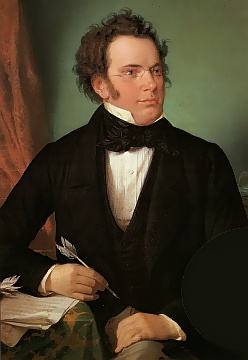
A good example of a characteristic Romantic melody may be found in the first movement of Franz Schubert’s 8th Symphony (known as the "Unfinished Symphony"). Notice the extraordinary richness with which Schubert treats the melody in the short two minutes that the following excerpt lasts:
Composer: Franz Schubert
-
"Symphony No. 8 in B Minor, D. 759 " [ 01:17-12:35 ]11:18
The flowing quality of the melody in this excerpt from the opera Aida by Giuseppe Verdi is also typical of Romantic period melodies. Notice especially the “upward sweep” in the fourth and final phrase of this excerpt.
Composer: Giuseppe Verdi
-
"Aida: Act II: Triumphal March" [ 01:52-02:36 ]00:44
Another example of a flowing melody—this time we can almost say literally flowing—may be found in the River Theme from The Moldau by Bedřich Smetana:
Composer: Bedrich Smetana
-
"Ma Vlast (My Country): No. 2. Vltava (Moldau)" [ 01:08-01:53 ]00:45
And still another in "O Mio Babbino Caro" from Puccini’s opera Gianni Schicchi:
Composer: Giacomo Puccini
-
"Gianni Schicchi: Gianni Schicchi: O mio babbino caro"