
What are the basic elements of the speech process?
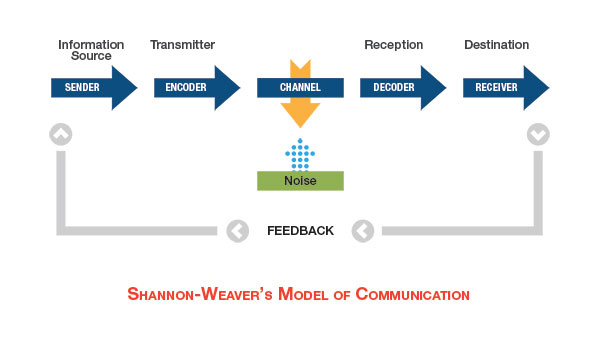
In 1947, Claude E. Shannon, a research mathematician working for Bell Labs, created a theory of communication designed to facilitate the transmission of information over telephone lines. Later, Warren Weaver added the component of feedback to Shannon’s linear model, thus making it, in effect, circular (Dyer, Hayden, and Lanctot, "University of Rhode Island Faculty Website"). The Shannon-Weaver Model is one of the most popular models used today for the study and analysis of inter-personal communication.
To understand how the Shannon-Weaver Model pertains to communication, we will consider each individual element of the model.
Source
The source of communication initiates the action, setting the entire model into motion. The source is an individual or group that begins the communication process. For example, an organization’s leaders are upset about the local government and want the mayor to resign in one week. The organization is the source, because they have an intended message.
Encoder
Once the source has determined the meaning of its message, the message needs to take a specific format. The encoder takes the concept that the source wants to communicate and formats it for later interpretations. In our example, one of the leaders of the organization calling for the mayor’s resignation acts as the encoder by delivering the message to a crowd.
Message
The information or idea that the source wants to send is called the message. In human communication, the message usually has a specific meaning. When the model was created, however, Shannon and Weaver were only concerned with a message's transmission, not its content or meaning. Continuing with the previous example, the message is, "The mayor must resign."
Channel
Next, an appropriate means to transmit the message is selected. The channel is the route through which the message is conveyed, and the channel can be verbal, written, or electronic. For instance, if the organization leader is speaking through a megaphone, face-to-face with a crowd of people, the channel of the message is verbal. If the leader’s speech is being filmed by a news crew for a television broadcast, the channel is electronic.