
Letter Names and Key Groups
Letter Names
The first seven letters of the alphabet, A to G, are used to identify the white keys on the keyboard. On a full-sized 88-note keyboard with 52 white keys and 36 black keys, the first key on the left corresponds to the letter A. The first key on most modern electronic keyboards or synthesizers is C. In the small keyboard below, for instance, the first white key on the left corresponds to the letter C. Click on that key, and notice that as you click consecutively to the right on the white keys of the keyboard, the letter names continue with D, E, F, G, A, and B. Each time you get to a B, it starts over again with C.
Also notice the recurring patterns, or groups of black keys. Black keys on the keyboard are grouped in patterns of twos and threes. These groups of two and three black keys provide useful visual clues for learning the names of notes on the keyboard.
Letter Names on the Keyboard
Notice that there is no black key between E and F or B and C.

Remember:
- A full 88-note keyboard has 52 white keys and 36 black keys.
- In a full 88-note keyboard, the first white key on the left corresponds to the letter A.
- In a full 88-note keyboard, the last white key on the right corresponds to the letter C.
Two Black-Key Group
The 2 black-key group consists of two black keys and three white keys. The white key between the black ones—the internal key—is labeled D. The two that surround the black keys—the external white keys—are labeled C and E. So, the pitch C always occurs to the immediate left of the 2 black key group. You can use this C as a visual anchor on the keyboard.
Click "Show Me" in the examples below (and in all subsequent examples) to see these concepts illustrated. After the animation, you will be prompted to try it out on your own (in this case, just click on the indicated keys).
Two Black Key Group-Internal Key: D
Two Black Key Group-External Keys: C and E
Remember:
- The pitch D occurs between the two black keys on the keyboard
- The pitch C occurs immediately to the left of any two black keys on the keyboard
- The pitch E occurs immediately to the right of any two black keys on the keyboard
Three Black-Key Group
The 3 black-key group consists of three black keys and four white keys. The white keys between the black ones—the internal keys—are labeled G and A (as illustrated below). The two keys that surround the black keys—the external white keys—are labeled F and B. So, the pitch F always occurs to the immediate left of the 3 black-key group. You can use this F as another visual anchor on the keyboard.
Three Black Key Group-Internal Keys: G and A
Three Black Key Group-External Keys: F and B
Remember:
- The pitches G and A occurs inside (internal) the three black keys groups on the keyboard.
- The pitch F occurs immediately to the left of any three black keys on the keyboard.
- The pitch B occurs immediately to the right of any three black keys on the keyboard.
- There is no black key between the white keys E and F or between B and C.
Here are all of the letter names for the white keys on the keyboard. Take a moment to memorize them now.
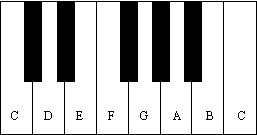
Letter names for white keys
The black keys on the keyboard may also be given letter names. But before we can name these, we need to learn more about half steps, whole steps, and accidentals.

- Memorize and recall quickly the letter names for each keyboard key.
- Recognize internal and external white keys in the two and three black-key groups.