
Compound Intervals
Up to this point, we have only dealt with intervals that are an octave or smaller (these are called simple intervals). Intervals that are larger than an octave (ninths, tenths, elevenths, and so on) are called compound intervals. There are a few tricks you can learn that will help you work with compound intervals.
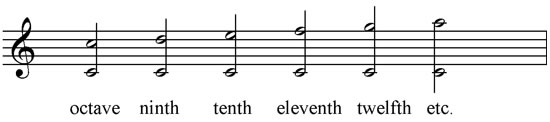
Compound intervals
Identifying Compound Intervals
The simplest way to identify a compound interval is to reduce it to a simple interval by removing any extra octaves. For example, if you had the interval from C4 to E5 (as shown in the example below), you can remove one octave, resulting in the simple interval C4 to E4 (Click on "Show Me"). This smaller interval is easier to identify (a major third). Note that you could also have moved the C up an octave to C5. The resulting simple interval would be the same.
Simplifying a compound interval
Now we can use this simple interval to determine the quality of the larger compound interval, using two rules. The first rule helps us to determine the numeric size.
| Compound Interval Rule 1 | ||||||
|
To determine the numeric size of a compound interval, add 7 for each octave larger than the simple interval
|
So, we can add 7 to any simple interval to figure out the size of the next-largest compound interval. If we add 7 to our major third (for the single octave we removed), you will see that we have a tenth (3 + 7 = 10), but what kind of tenth is it? To determine this, we need another rule:
| Compound Interval Rule 2 |
| Compound intervals have the same quality as their corresponding simple intervals |
This rule tells us that since our simple interval is major, the compound interval will also be major. So in this case, our compound interval would be a major tenth (click "Show Me" below to see this illustrated). Note that musicians often refer to compound intervals by their simple interval names, ignoring any extra octaves between the two pitches. So you might hear someone refer to this a major third, although it is more precisely a major tenth.
Identifying a compound interval
Take a moment now to practice identifying the compound intervals below. When you think you know what the answer is, click "Show Me" to see the correct identification.
Identifying various compound intervals
m10 m3
Spelling a compound interval
Spelling Compound Intervals
You can use the same concepts to help you spell compound intervals, using the following steps:
- Reduce the compound interval to a simple interval
- Spell the simple interval
- Add the octave(s) back in to create the compound interval
For example, if you were asked to spell a perfect eleventh above middle C, you would first reduce it to a simple interval. This gives you a perfect fourth, since 11-7=4 and since the quality of the simple interval will be the same as the compound one. Next, you would spell a perfect fourth above C4, which gives you an F4. Lastly, you would move this F up an octave to F5 to create a perfect eleventh. Click "Show Me" in the example below to see this process illustrated.
Spelling a compound interval