
Other Seventh Chords
| Common name | Chord on C | Common symbols on C |
Intervals from root | Quality of consecutive thirds | ||||
|---|---|---|---|---|---|---|---|---|
| Third | Fifth | Seventh | 1st | 2nd | 3rd | |||
| Major seventh |
 |
Cmaj7 CM7 CΔ7 CΔ |
major | perfect | major | major | minor | major |
| Minor seventh |
 |
Cmin7 Cm7 C−7 |
minor | perfect | minor | minor | major | minor |
| Dominant seventh |
 |
C7 | major | perfect | minor | major | minor | minor |
| Diminished seventh |
 |
Co7 Cdim7 Cm(♭7)♭5 C-(♭7)♭5 |
minor | diminished | diminished | minor | minor | minor |
| Half-diminished seventh |
 |
Cm7♭5 C−7♭5 Cø |
minor | diminished | minor | minor | minor | major |
| Minor major seventh |
 |
Cmmaj7 CmM7 CmΔ7 C−Δ7 |
minor | perfect | major | minor | major | major |
| Augmented major seventh |
 |
Cmaj7♯5 C+M7 C+Δ7 |
major | augmented | major | major | major | minor |
A seventh chord is a chord consisting of a triad plus a note forming an interval of a seventh above the chord's root. When not otherwise specified, a "seventh chord" usually means a dominant seventh chord: a major triad together with a minor seventh.
We will see, however, that a variety of sevenths may be added to a variety of triads, resulting in many different types of seventh chords, for instance, major, minor, diminished, half-diminished, and fully-diminished. We will consider each of these types in turn.
Major Seventh Chords
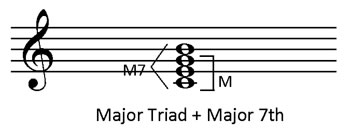
Let's start by examining the seventh chord that occurs above the tonic (C). Like the dominant seventh chord, this has a major triad on the bottom (C-E-G). But unlike the dominant seventh chord, this has a major seventh above the root (C-B), as illustrated in the following example. Thus, instead of a major-minor seventh chord, this is a major-major seventh chord (typically abbreviated as major seventh chord).

Remember
- The major seventh chord consists of a major triad with a major seventh added above the root
- Common symbols for the major/major chord are:
Cmaj7
CM7
CΔ7
CΔ
You can also think of the major seventh chord as a major triad with a major third stacked on top. Both approaches will provide the same result. Major seventh chords occur naturally over scale degrees 1 (C-E-G-B) and 4 (F-A-C-E), as illustrated below. To distinguish major seventh chords from dominant sevenths, a capital letter "M" is typically added after the letter of the root: CM7, FM7.

Major seventh chords in C major
Minor Seventh Chords
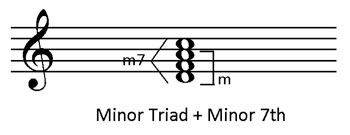
Now let's look at the seventh chord that occurs above scale degree 2 (D). Unlike the others we have seen, this seventh chord has a minor triad on the bottom (D-F-A). It also has a minor seventh above the root (D-C), making it a minor-minor seventh chord, as illustrated in the following example. Its abbreviated name is minor seventh chord.
Remember
The minor seventh chord consists of a minor triad with a minor seventh added above the root.
You can also think of the minor seventh chord as a minor triad with a minor third stacked on top. Both approaches will provide the same result. Minor seventh chords occur naturally over scale degrees 2 (D-F-A-C), 3 (E-G-B-D), and 6 (A-C-E-G), as illustrated below. They can be represented with a lowercase letter representing the root, a lowercase m, and the number 7: dm7, em7, am7.

Minor seventh chords in C major
Half-Diminished Seventh Chords
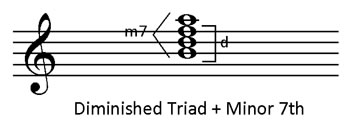
The only other diatonic seventh chord in major keys occurs above scale degree 7 (B-D-F-A). This seventh chord has a diminished triad on the bottom (B-D-F) and a minor seventh above the root (B-A), as illustrated in the following example. The name of this chord is the half-diminished seventh chord (since it has a diminished triad but does NOT have a diminished seventh).
Half-diminished seventh chord
Remember
The half-diminished seventh chord consists of a diminished triad with a minor seventh added above the root.
You can also think of the half-diminished seventh chord as a diminished triad with a major third stacked on top. Both approaches will provide the same result. In major keys, only the seventh on scale degree 7 (B-D-F-A) is half-diminished, as illustrated below. Half-diminished seventh chords can be represented with a lowercase letter representing the root, followed by a small circle symbol with a slash through it (signifying "half-diminished") and a 7: for example, bø7.

Half-diminished seventh chord in C major
Fully-Diminished Seventh Chords
The last type of seventh chord does not occur naturally in major keys, but it can be found in minor keys. Here are the diatonic seventh chords in C minor:

Fully-diminished seventh chord in C minor
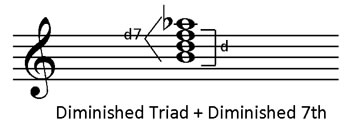
You'll notice that almost all of the types of seventh chords in minor are different than those in major. It will not be necessary to study and memorize all of these differences, however. What we are focusing on here is the final chord on scale degree seven. With the leading tone raised, this seventh chord has a diminished triad on the bottom (B-D-F) and a diminished seventh above the root (B-natural to A♭), as illustrated in the following example.
Diminished seventh chord structure
Since both the triad and the seventh are diminished, this chord is called the fully-diminished seventh chord, or more concisely, the diminished seventh chord. This chord is a favorite of many composers because of its especially tense, dramatic sound.
Remember
The fully-diminished seventh chord consists of a diminished triad with a diminished seventh added above the root.
You can also think of the diminished seventh chord as a diminished triad with a minor third stacked on top, or as a seventh chord built entirely out of minor thirds (three minor thirds stacked on top of each other). Diminished seventh chords can be represented with a lowercase letter representing the root, followed by a small circle and a 7, like this: b°7.
Summary
Perhaps the best way to summarize the five types of seventh chords is to compare them directly to each other, as in the following example. Click on the speaker to hear these chords played and arpeggiated.

The five types of seventh chords
When laid out in this order, you can see that there is only a semitone difference between adjacent seventh chords. The major seventh chord has a major triad and a major seventh. Lower the seventh and you have a dominant seventh chord (a major triad and a minor seventh). Lower the third of this and you have a minor seventh chord (a minor triad and a minor seventh). Lower the fifth and you have a half-diminished seventh chord (a diminished triad and a minor seventh). Finally, lower the seventh again and you have a fully-diminished seventh chord (a diminished triad and a diminished seventh). Click on the speaker to hear the five types of seventh chords again, listening carefully to these semitone changes.