
Learning Objectives
- Examine the three categories of meter: simple, compound, and asymmetric.
- Learn the distinction between simple and compound meters.
Meter Types I: Introduction
Meter Types
There are three different types of meters: simple meter, compound meter, and irregular meter. The meter types that we have discussed so far have all been simple meters, such as 3/4 and 4/4 meter. In this section of the course, we will look at all of the meter types and their time signatures. We will also learn how to count and conduct in different types of meter.
Simple vs. Compound
Most meters that you will encounter will be either simple or compound. Irregular meters are less frequently found. The principal difference between simple and compound meters is how the beat is divided. In simple meters, the beat is divided into two parts. Click "Show Me" in the example below to see how each beat is divided into two parts.
Division of the beat in simple meters
By contrast, in compound meters, the beat is divided into three parts. Click "Show Me" in the example below to see how each beat is divided into three parts.
Division of the beat in compound meters
Both of the meters illustrated above (2/4 and 6/8) are duple meters, since they both have two beats per measure. What makes them sound different is the way those beats are divided. They are also notated somewhat differently, as we will see in later lessons.
| Remember |
|
The Top Number
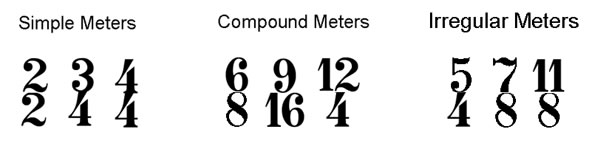
One quick way to distinguish betwen simple and compound meters is to look at the top number of the time signature. If the number on top is 2, 3, or 4, then the meter is simple (as illustrated below). If the number on top is 6, 9, or 12, then the meter is compound. If the number on top is something else, such as a 5, 7, or 11, then the meter is going to be irregular. This is just a rule of thumb, however. In the lessons that follow, we will discuss more specifically each of the meter types and their characteristics.
| Remember |
|