
Learning Objectives
- Examine compound duple meter, using the time signatures 6/8, 6/16, and 6/4.
- Practice counting and conducting compound duple meter.
Meter Types VI: Compound Duple Meter
Compound Duple Meter
Compound duple meter has two beats per measure, with each beat is divided into three equal parts.
| Remember |
|
Counting Compound Duple
Compound duple meter is counted as follows (here a dotted-quarter note value is used as the beat):
| Beat |  ONE |
TWO |
| First division |  ONE la le |
TWO la le |
| Second division | 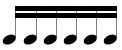 ONE ta la ta le ta |
TWO ta la ta le ta |
Try counting the beat first (ONE TWO), then add the divisions (ONE la le TWO la le) while continuing to tap the beat on the table. Note that you can further divide the beat into six parts in a compound meter by adding a "ta" between all of the syllables (ONE ta la ta le ta TWO ta la ta le ta).
Conducting in Duple
The conducting pattern for compound duple is the same as the pattern for simple duple, since both have two beats:
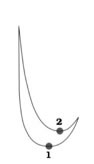
Practice this conducting pattern while counting ONE - TWO. For compound meter, you might want to mentally divide each beat into three parts. Be sure to practice conducting with the examples that follow.
Time Signatures
The top number in a compound duple time signature is always the number six (6). The most common compound duple time signature is 6/8. The 6/16 and 6/4 time signatures discussed below are far less common.
Six-eight meter

The top number (6) in the six-eight time signature tells us that there are six equal divisions of the beat per measure. The bottom number (8) indicates that each one of those divisions is an eighth note. Dividing the top number in the time signature by three tells us that there are two beats in each measure. Each of those beats is worth three eighth notes (that is, three of the bottom number). The single note that represents three eighth notes is a dotted quarter note. Therefore, the value of the beat in 6/8 is a dotted quarter note. Click on the music below to hear a metric pattern played in 6/8. Try to conduct and count the beats (ONE TWO) as you listen.

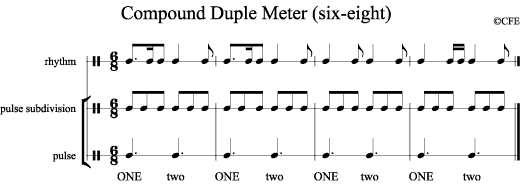
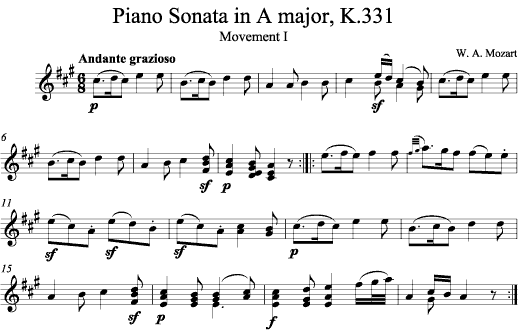
The rhythmic pattern used in the example above is actually the basis for the main theme in the following piano sonata by W. A. Mozart (1756-1791). Click on the score below to hear the music played. Remember to conduct and count the beats as you listen.
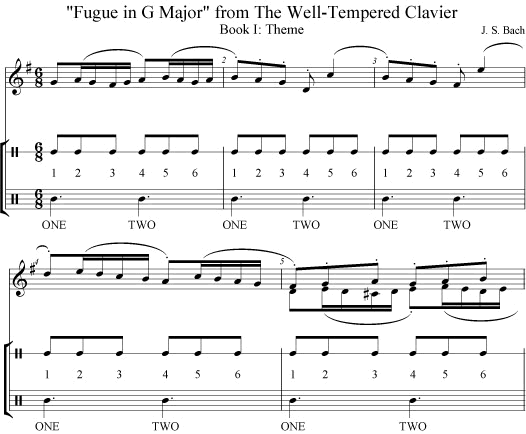
The Fugue in G Major from Book I of The Well-Tempered Clavier by J. S. Bach (1685-1750) is also written in 6/8 time. (The two rhythmic lines that have been added here represent the pulse and the division of the pulse, which are played along with the theme.)

The top number (6) in the six-sixteen time signature tells us that there are six divisions per measure. The bottom number (16) indicates that each one of those divisions is a sixteenth note. Dividing the top number in the time signature by three tells us that there are two beats in each measure. Each of those beats is worth three sixteenth notes (three of the bottom number). The single note that represents three sixteenth notes is the dotted eighth note. Therefore, the value of the beat in 6/16 is a dotted eighth note.
Six-four meter

The top number (6) in the six-four time signature tells us that there are six divisions per measure. The bottom number (4) indicates that each one of those divisions is a quarter note. Dividing the top number in the time signature by three tells us that there are two beats in each measure. Each of those beats is worth three quarter notes (three of the bottom number). The single note that represents three quarter notes is the dotted half note. Therefore, the value of the beat in 6/4 is a dotted half note.
In the next lesson we will look at compound triple meter.