
Learning Objectives
- Define the triad as a chord of three pitches consisting of stacked major or minor thirds
- Distinguish between the root, third, and fifth of the triad and identify triads by their roots.
Triads I: Triad Basics
Chords
Up to this point,we have concentrated primarily on the melodic aspect of music (pitches that occur one after the other). We are now going to shift our focus to the harmonic aspect of music (pitches that occur simultaneously). Remember that two simultaneous pitches create a harmonic interval. When more than two pitches are played simultaneously, the resulting sonority is a chord. In this section of the class, we will discuss three-note chords. In the final section of the course, we will also introduce four-note chords. This accounts for most of the chords used in Western tonal music.
Triads
A triad is a chord with three notes in it. Triads are the basic harmony of tonal music. The notes of a triad can always be stacked on top of each other on the staff (putting the pitches on three consecutive lines or three consecutive spaces). Stacking two thirds in this way also creates the interval of a fifth from the bottom note to the top note (as shown in the example below). Here, a triad is built on F by stacking an A and a C on top of it, creating a third from F to A, a third from A to C, and a fifth from F to C.
A triad
Click on the speaker in the example above to hear the triad played. You can also click on the intervals that make up the triad or on the individual pitches.
Triad Components
When the notes of a triad are stacked neatly on top of one another, we say that the chord is in root position. When in root position, the lowest note of a triad is called the root. The other two notes are named after the interval created above the root. Thus, the middle note is the third and the top note is the fifth (as illustrated below).
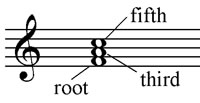
In the triad shown here (F-A-C), F is the root, A is the third, and C is the fifth. Click on the speaker to hear these triad components played simultaneously, then consecutively (root ... third ... fifth). When the notes of a chord are played one after the other (or "arpeggiated"), it is sometimes referred to as a broken chord.
Triad Names
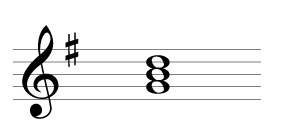
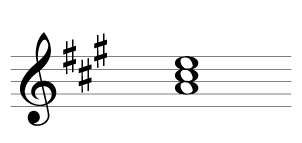
The root is the most important note in a triad. For this reason, triads are named after their roots (the lowest note of the chord when the chord is in root position). See, for example, the following two triads. The root of the G major triad is G and the root of the A major triad is A. Click on the speakers to hear these two triads played.
| Remember |
|
The other part of the triad name indicates the quality of the triad (e.g., a G major triad or a G minor triad). We will learn about triad qualities in the next lesson.
Triads and Scales
We have seen how triads can be built by stacking thirds. Triads can also be derived fom scales. If you take every other scale degree from any scale (for a total of three pitches) it will form a triad. For example, if you had a C major scale (as in the example below) and you took scale degrees 1 (the tonic), 3 (the mediant), and 5 (the dominant), these would become the root, third, and fifth of a C major triad. (Click "Show Me" in the example below to see this illustrated.)
Triads
You can build a triad on any scale degree in the scale. For example, try clicking on scale degrees 2, 4, and 6 on the staff. This will give you a D minor triad. Now click on scale degrees 4, 6, and 8. This gives you an F major triad. What makes a triad major or minor? That is what we will learn in our next lesson.