
Learning Objectives
- Examine some of the most common harmonic progressions (chord successions) in tonal music.
Harmony IV: Harmonic Progressions
Harmonic Progressions
We have now learned about all of the diatonic triads and seventh chords in major and minor keys. In musical phrases, these chords do not move randomly from one to the other. Instead, they are ordered into harmonic progressions, creating meaningful "musical sentences." There are many possible chord progressions that work well, just as there are many ways of forming grammatical sentences. In this lesson, we will focus primarily on chord progressions involving the tonic, dominant, and subdominant and those based on the circle of fifths.
Tonic and Dominant
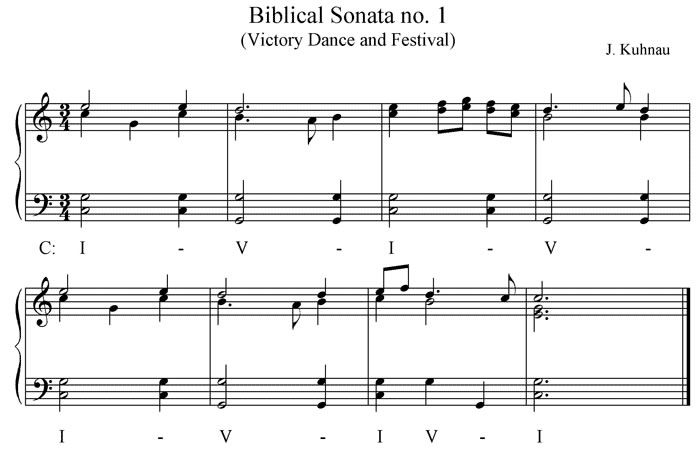
The most basic chord progression involves just two chords: the tonic triad and the dominant triad. The tonic acts as a center of gravity and point of rest in harmonic progressions. The dominant acts as a counterbalance to the tonic, providing tension that resolves convincingly back to the tonic. The basic progression I - V - I represents a point of stability, a departure, and a return. This progression can be intensified by adding a seventh to the dominant.
Here is a musical example that uses only the tonic and the dominant. Click on the speaker to listen to it. Note how these two tonal functions alone can create a convincing harmonic progression.
Tonic, Dominant, and Subdominant
The subdominant triad is frequently used to prepare the dominant function, acting as a predominant chord. One typical progression is I - IV - V - I, with the tonic moving to the predominant and the dominant resolving back to the tonic. Here is a musical example that illustrates this very common chord progression.
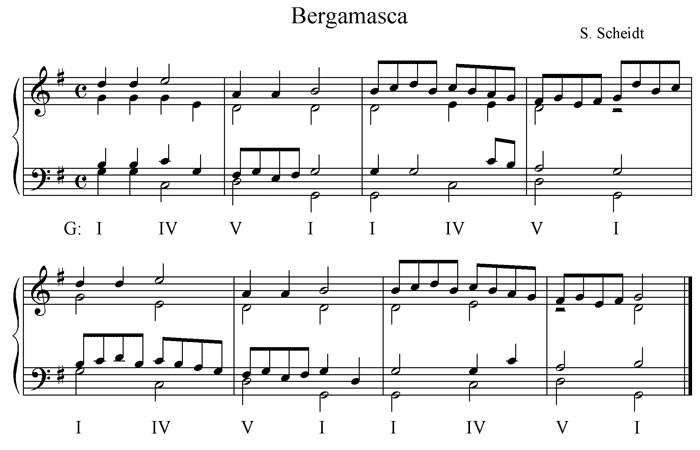
The tonic, subdominant, and dominant triads (I, IV, and V) are sometimes known as primary triads because of their significant structural role in harmonic progressions. Many harmonic progressions contain only primary triads. These three triads alone can quite effectively establish any key, since they present all of the pitches of the scale (scale degrees 4, 6, and 1 in the IV chord, 5, 7, and 2 in the V chord, and 1, 3 and 5 in the I chord).
Circle of Fifths Progressions
The other triads (ii, iii, vi, and viio) occur with varying amounts of frequency. Of these, the supertonic chord (ii) is the most common, often progressing to V as a predominant chord. In fact, the chord progression ii-V-I is the final part of a longer circle-of-fifths progression that is particularly common in tonal music. The full circle-of-fifths progression starts at the tonic and descends by fifths through all of the other diatonic harmonies until it returns to the tonic, as follows:
I - IV - viio - iii - vi - ii - V - i (in major)
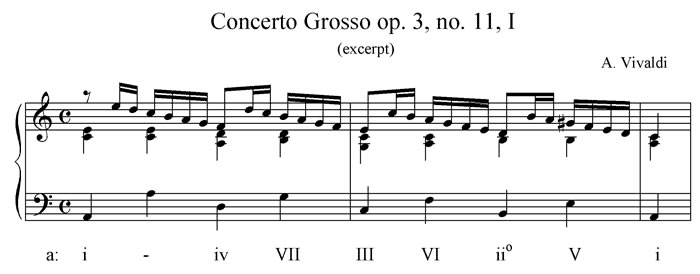
i - iv - VII - III - VI - iio - V - i (in minor)
Here is a musical example that is based on the circle of fifths in minor. Click on the speaker to hear how it starts on the tonic, travels around the circle and arrives convincingly back on the tonic.
It is not necessary to go all the way around the circle from tonic to tonic. Any part of the circle-of-fifths chord progression can be used effectively in a musical phrase. All of the progressions we have examined illustrate the tendency of harmonic progressions to move back towards the tonic. This is one of the basic principles of harmony.