
Objectives
- Explain how the Classical period (1750-1825) characteristics of order, objectivity, and harmonious proportion relate to the music characteristics of the period.
- Summarize how the American Revolution (1775-83) and the French Revolution (1789-99) profoundly changed political systems and social order.
- Classify the large-scale musical forms in which the Classical masters composed.
- Explain music making in the context of the royal court and the patronage system.
- Define form and absolute music, and relate these concepts to one another.
- Differentiate between the main musical forms of the Clasical-era by summarizing the development of the symphony, sonata, string quartet, and the concerto.
- Define and analyze the symphony, sonata, string quartet, and concerto forms in the context of the Classical period.
- Describe the impact of the major Classical composers Haydn, Mozart, and Beethoven.
- Discuss the impact of Beethoven's thirty-two piano sonatas.
- Compare and contrast the two types of Italian opera: opera buffa and opera seria.
Aspects of Art in the Classical Period (1750-1820)
The intersection of two worlds
The Classical period represents the intersection between a dying world, which sought to rediscover the glory of ancient Greece and Rome, and a new world seeking change and equality. It is only natural, therefore, that the arts of the time contain elements of both worlds.
It would be a mistake, however, to think the search for pure form was the only characteristic of the period. The age of reason was also an age of revolution, with much of it taking place under the shadow of the guillotine. The political instability of the time was reflected in its visual art, and of course, in its music.
Just as the elegant prose of Edward Gibbon (1737-1794) and Dr. Samuel Johnson (1709-1784) gave way to the gothic outpourings of the English novelist Mary Shelley (1797-1851), so the symmetry found in Gluck, Haydn, and Mozart was undermined by the revolutionary approach of Beethoven.
The writings of the era foreshadow the emotional upheaval that would culminate in Romanticism. Most notable among these movements was the literary Sturm und Drang (Storm and Stress) of Germany, whose leaders were Friedrich von Schiller (1759-1805) and Johann von Goethe (1749-1832).

The writings of the era foreshadow the emotional upheaval that would culminate in Romanticism...

Painting and Architecture
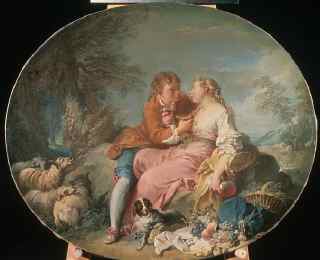
For much of this period, the visual arts, dominated by the late baroque style called rococo, did not reflect the rising tide of reason and simplicity. The rococo style emphasized elegance, softness, and playfulness. Interiors were decorated with beautiful gold-and white curved wood, crystal chandeliers, pastel colors and gilt ceilings.
The sensibilities of the growing middle class are clearly portrayed in the plays of Pierre Beaumarchais (1732-1799), whose Marriage of Figaro (1784) was so disturbing to the aristocracy that it was banned in Vienna, and nearly banned in Paris. In 1786, however, Mozart recreated the play as an opera that enjoyed great success.
The greatest painter of the French rococo is Jean Antoine Watteau (1684-1721), whose works exhibit the light, yet ornate touch of artists of the period. Later classical artists turned to portraiture as a way of capturing the elegance of the subject. Some of the famous paintings of this time include The Duchess of Devonshire by Sir Joshua Reynolds (1723-1792), The Blue Boy by Thomas Gainsborough (1727-1788), and Paris and Helen by Jacques Louis David (1748-1825). The art of Henry Fuseli (1741-1825) characterizes the interest in dark subjects of the Sturm und Drang artists.
Classical architecture reflects the revival of interest in Greek and Roman themes. Buildings constructed in the United States during the period, such as those designed by Thomas Jefferson, include columns and arches identical to those found on ancient buildings such as the Parthenon in Athens or the Coliseum in Rome.
In the 1790s, Napoleon's counterpart in the arts was Jacques-Louis David (1748-1825), a painter who became a kind of art dictator during the French Revolution and whose greatness, before the 1820s, was undisputed. David painted solemn scenes of noble sacrifice and great historical moments in a clear, balanced, linear style. In the arts, as in politics, the French Revolution was the culmination of the spirit of reform from preceding generations.
Women in Music
The absence of women in the history of music is conspicuous and disturbing. Other than Hildegard of Bingen, a significant medieval composer, no female musicians have received historical recognition, let alone risen to the level of mastery of, for example, Bach or Haydn. Why is that?
The simple truth is that women were not allowed equal access to any of the musical opportunities that men enjoyed. Women were not even allowed to sing the female roles in opera until the 18th century! If a woman did show skill and ability at an early age, several forces would combine to quell her ambition. First, the culture of the times dictated that the role of women was to stay home and raise children. Second, only women of aristocratic households had access to musical education. Finally, even if a woman did receive some education in composition, patrons, publishers, and concert promoters were very reluctant to hire her or publish her music.
Therefore, although quite a few were able to become prominent musicians, it was rare (until well into the 20th century) for a woman to achieve prominence as a composer. The exceptions to this rule were usually women with strong character who came from aristocratic families.
For example, Elizabeth Jacquet de la Guerre, a French Baroque composer, wrote excellent suites for the harpsichord. Two sisters of famous composers, Marianne Mozart and Fanny Mendelssohn, had the ability to become significant composers, but gave up their careers to raise families. (Felix Mendelssohn published some of Fanny' s music under his own name). Perhaps the most important woman in Romantic music is Clara Schumann, the wife of Robert Schumann and a lifelong friend of Johannes Brahms. She was a brilliant composer in her own right, and toured Europe as a concert pianist to high acclaim.
In the 20th century, the trend slowly began to change. Nadia Boulanger taught composition to some of the century's greatest composers, including Germaine Tailleferre, a woman who was a member of the French school known as Les Six. Currently, many women are prominent composers, including Thea Musgrave, Libby Larsen, and Joan Tower.



