
Objectives
- Explain how the Classical period (1750-1825) characteristics of order, objectivity, and harmonious proportion relate to the music characteristics of the period.
- Summarize how the American Revolution (1775-83) and the French Revolution (1789-99) profoundly changed political systems and social order.
- Classify the large-scale musical forms in which the Classical masters composed.
- Explain music making in the context of the royal court and the patronage system.
- Define form and absolute music, and relate these concepts to one another.
- Differentiate between the main musical forms of the Clasical-era by summarizing the development of the symphony, sonata, string quartet, and the concerto.
- Define and analyze the symphony, sonata, string quartet, and concerto forms in the context of the Classical period.
- Describe the impact of the major Classical composers Haydn, Mozart, and Beethoven.
- Discuss the impact of Beethoven's thirty-two piano sonatas.
- Compare and contrast the two types of Italian opera: opera buffa and opera seria.
The Classical Period (1750-1820): W. A. Mozart
Wolfgang Amadeus Mozart
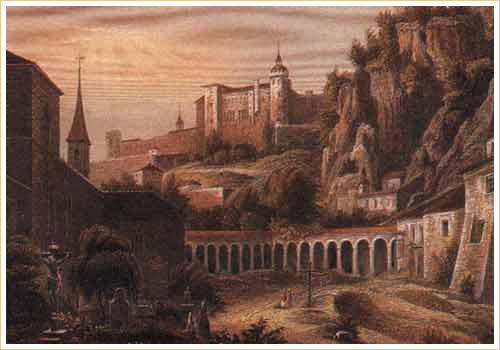
Salzburg, located in what is now Western Austria, had a reputation in the middle of the 18th century as a thriving center for the arts. Leopold Mozart, assistant director of the Archbishop's chapel and a composer of some ability lived there with his wife Maria Anna and their two children, Marianne (nicknamed Nannerl) and Wolfgang Amadeus.
Leopold soon recognized the incredible musical abilities of both of his children, but while tales of Wolfgang's youthful genius are well known, one can only wonder, if she had been afforded the same opportunities, how far Marianne would have gone.
Leopold devoted himself entirely to the boy's musical education and training, and by the age of three he was playing the clavier; by the age of five he had composed his first short works; by the age of six he (and his sister) had performed at the court of Empress Maria Theresa. By the time Mozart was a young teenager, he had toured every major city in Europe and written well over a hundred compositions.
The adulation, constant touring, and relentless prodding of his father took its toll on the young Wolfgang. The young prodigy began making fewer trips, often accompanied only by his mother. On one such trip, to Paris in 1778, his mother fell ill and died. While Leopold, who had stayed home in Salzburg, never openly accused Mozart, he hinted that the young man's negligence was partly responsible for his mother's death:
You had your engagements, you were away all day, and as she didn't make a fuss, you treated her condition lightly. All this time her illness became more serious, in fact mortal and only then was a doctor called in, when of course it was too late.
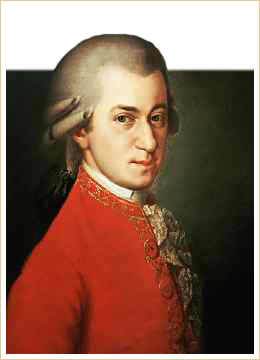
Wolfgang returned home at his father's request, but, while all of Europe was at his beck and call, he resented being treated as an employee of the provincial court of Salzburg. Most of all, he resented the overbearing presence that his father exerted in his life.
Mozart finally broke with his father in 1781 and moved to Vienna, which had become the musical capital of Austria, largely due to the presence of Haydn. Later that year, despite his father's objections, he married Constanze Weber, who was as poor and impractical in financial matters as he. Although the marriage was fraught with arguments, evidence suggests that their love was genuine. Often their disagreements were over money, which Mozart was never very good at handling. While some of his compositions (the piano concertos, for instance) provided a good income, the operas, which comprised much of Mozart's compositional output during the last decade, were inconsistent in their financial success. Although some, such as Le Nozze di Figaro were financially profitable, others closed after short runs.
The final year of his life, 1791, was one of his most productive financially and artistically. He composed The Magic Flute, La Clemenza Di Tito, a clarinet concerto, his last piano concerto, numerous pieces of chamber music, and his final choral work, the Requiem Mass, a powerful final statement.
The Lachrimosa dies illa is as beautiful as anything Mozart composed, even though he may not have written the entire movement himself. The mystery surrounding this work arose from the way in which it was commissioned and completed. An unknown messenger approached Mozart with a letter asking him to write a Requiem setting, the traditional Latin mass for the dead. As Mozart worked on the mass, he began to feel that the music mirrored his own illness and that he was writing the music for his own death. We now know that a Count Franz Walsegg commissioned the work, probably with the intention of passing it off as his own, as he was known to do. When Mozart died, however, he left the Requiem only half-complete with sketches for the remainder. The work as we know it today contains Mozart's music, along with the rest of the mass which was completed by Mozart's student Franz Süssmayr.
"Lachrimosa (From Requiem in D minor, K. 626)"Wolfgang Amadeus Mozart (1756-1791)
Composer: Wolfgang Amadeus Mozart
-
"Requiem in D minor, K. 626: Lacrimosa dies illa"

When Mozart died, however, he left the Requiem only half-complete with sketches for the remainder. The work as we know it today, contains Mozart's music, along with the rest of the mass which was completed by Mozart's student Franz Süssmayr...

Mozart's Musical Accomplishments
In his brief lifetime, Mozart composed over 600 pieces of music, a quantity made even more impressive by its astonishing quality. (In contrast, Schubert wrote more music in a shorter span, but his music is not consistently brilliant until later in life). Mozart's earliest masterworks date from his late teenage years. He left an indelible mark in every genre: chamber music, piano music, concerto, symphony, opera and choral music. He may be the single most brilliant figure in the history of Western music. Here, we will focus on his impact on keyboard music, the symphony, concerto, and opera.
Since Mozart made his first impression on the European musical world as a pianist, it is not surprising that his initial fame as a composer came from keyboard works. The F major Sonata for piano, K. 332, was written during the composer's extended visit to Paris in 1778. It follows the Classical fast - slow - fast pattern, which, by this time, had become the standard.
Mozart's style is characterized by his inventive and playful use of thematic development.
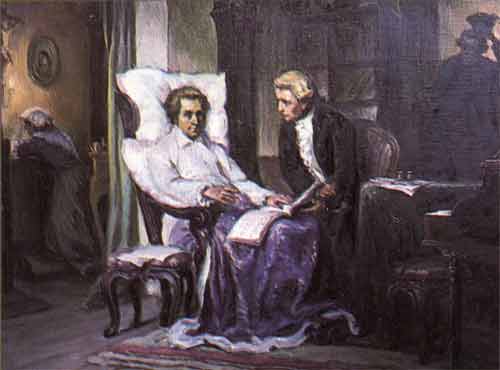
Another typically Mozartean characteristic is the achingly beautiful melody of the slow movement. As may be heard here, Mozart's themes are sometimes long, lyrical lines that can also be broken into smaller motives for later development. Mozart also wrote numerous sonatas for violin and piano that are among the greatest for that combination of instruments.
Sonata in F Major, K.332
W.A. Mozart (1756-1791)
I movement
Composer: Wolfgang Amadeus Mozart
-
"Sonata in F Major, K.332: First Movement"
II movement
Composer: Wolfgang Amadeus Mozart
-
"Sonata in F Major, K.332: Second Movement"
III movement
Composer: Wolfgang Amadeus Mozart
-
"Sonata in F Major, K.332: Third Movement"
His symphonies (particularly the late ones) are some of the most brilliant works in the orchestral repertoire. The Symphony No. 40 in G Minor, K. 550 (I movement - II movement), for instance, combines all of the complexity and emotional power of Beethoven's symphonies with the formal strength of Haydn.
Composer: Wolfgang Amadeus Mozart
-
"Symphony No. 40 in G Minor, K. 550: I. Molto allegro"
Composer: Wolfgang Amadeus Mozart
-
"Symphony No. 40 in G Minor, K: 550, II. Andante"
In 1781, Mozart left Salzburg for Vienna. Seeking new sources of income, he turned to writing concertos for orchestra and piano, a relatively new instrument at that time. Over the course of the next eight years, he wrote sixteen piano concertos. (He had composed several in Salzburg, and would write one more in 1791, the year of his death). Mozart's seventeen Viennese concertos (along with the ones that were written for the French horn and the clarinet) forever altered the concerto form.
In these works, the piano is placed squarely in the front of the musical texture. Replacing the solo/ritornello structure of the Baroque concerto grosso is a sonata allegro form with two separate expositions: one featuring the orchestra, and one featuring the solo piano. In other words, Mozart's concertos are an extension of his approach to the symphony. This new conception of the concerto changed the way that later composers, including Beethoven, wrote for the genre.
Piano Concerto In C Major, K. 467
W.A. Mozart (1756-1791)
I movement
Composer: Wolfgang Amadeus Mozart
-
"Piano Concerto No. 21 in C Major, K. 467 "Elvira Madigan": I. Allegro maestoso"
II movement
Composer: Wolfgang Amadeus Mozart
-
"Piano Concerto No. 21 in C Major, K. 467: II. Andante (Featured in "Elvira Madigan")"
The Piano Concerto in C Major, K. 467, written in 1784, is a fine example of Mozart's mastery of the form. The opening movement is a sonata-allegro form with grace and power, while the 2nd movement andante is full of pathos and longing. Maynard Solomon refers to several moments in the 2nd movement that illustrate time-stopping beauty, blending chromatic pathos and measured tranquility:
- Measure 24: triplet rhythm placed against 16th note rhythm
- Measure 28: triplet rhythm placed against 8th note rhythm
- Measure 30: the high floating melody sabotaged by a large leap down 3 octaves
- Measure 36: sudden chromatic departure from the key of F major
Mozart's Musical Style
Before we discuss Mozart's musical style, it is fascinating to examine his approach to composition. Most composers have ideas about a work when they start writing. They jot those thoughts down, work through them at the keyboard, and create sketches of the work in progress. When they reach a point where the music is ready, they transfer the musical ideas from the sketch to a score. Nowhere in any of Mozart's belongings, letters, or scores has anyone found sketchbooks. One of Mozart's letters indicates that he committed his ideas to paper only after they were sufficiently worked out in his mind. Given the quantity and quality of his music, this is an astounding fact. His original scores are beautiful, clean, and unmarred by corrections or changes.
It is interesting that the emotional traumas, which surely plagued Mozart during most of his life, are nowhere to be found in his music. Unlike Beethoven, whose life experiences are nearly biographically chronicled in his music, or Bach, whose religious devotion is mirrored in the complexity of his polyphony, Mozart's music exists as absolute music. No other composer has written music of such beauty that is simultaneously complex and simple. To understand the character of his music, we will compare his fast works (first movements, overtures) with his slow music (slow movements, slow arias).
The fast works by Mozart often exhibit a playfulness similar to that of Haydn. In these works, Mozart most closely resembles the older master. Listen to each piece listed below, drawn from different phases in his life.
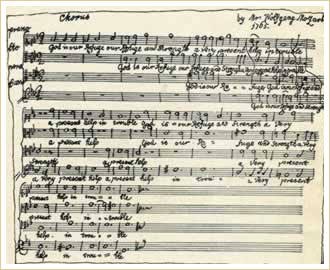
All of them (even the ones written in his late teens) show a mastery of form and a mischievous character. The exception is the first movement of the G minor Symphony, which replaces playfulness with seriousness, although not to the degree that it becomes overwrought.
Piano Sonata in F major, K. 332, 3rd movement (1778)
Composer: Wolfgang Amadeus Mozart
-
"Sonata in F Major, K.332: Third Movement"
Piano Concerto in C-major, 1st movement (1784)
Composer: Wolfgang Amadeus Mozart
-
"Piano Concerto In C Major, K. 467: First Movement"
Eine Kleine Nachtmusik, 1st movement (1787)
Composer: Wolfgang Amadeus Mozart
-
"Serenade No. 13 in G Major, K. 525 "Eine kleine Nachtmusik": Allegro"
Symphony No. 40 in G minor, 1st movement (1788)
Composer: Wolfgang Amadeus Mozart
-
"Symphony No. 40 in G Minor, K. 550: I. Molto allegro"
Madamina from Don Giovanni (1787)
Composer: Wolfgang Amadeus Mozart
-
"Don Giovanni: Madamina! (Catalogue Aria)"
Mozart's melodic genius shines through in his slow music. His melodies are so beguiling that they mask the complexity and power of their structure. Maynard Solomon, one of Mozart's biographers, has observed that one can sense just a hint of sadness in the slow movements and that his melodic motives often contain a suggestion of discontent. Note the brief dissonance in the opening melody of the piano concerto movement, the subtle sobbing motif of the Eine Kleine Nachtmusik melody, and the pain of the Lachrimosa from the Requiem.
F major sonata for piano, K. 332, 2nd movement (1778)
Composer: Wolfgang Amadeus Mozart
-
"Sonata in F Major, K.332: Second Movement"
Piano Concerto in C-major, 2nd movement (1784)
Composer: Wolfgang Amadeus Mozart
-
"Piano Concerto In C Major, K. 467: Second Movement"
Eine Kleine Nachtmusik, 2nd movement (1787)
Composer:
-
"Serenade No. 13 in G Major, K. 525, "Eine kleine Nachtmusik": II. Romance"
Symphony No. 40 in G minor, 2nd movement (1788)
Composer: Wolfgang Amadeus Mozart
-
"Symphony No. 40 in G Minor, K: 550, II. Andante"
Lachrimosa from Requiem (1791)
Composer: Wolfgang Amadeus Mozart
-
"Requiem in D minor, K. 626: Lacrimosa dies illa"
Mozart's music achieves a complete synthesis with all of the musical experiments of the previous 500 years. It also is the doorway through which all compositional development would flow for the next 150 years. In the perfection that Mozart's music embodies, there is a tiny kernel of unrest and anguish. It is a pain that was most likely felt in his own life; his art and life, however, were clearly two distinct, separate entities. The expression of emotional pain and joy through music would be left for the next great Classical composer that we will study: Ludwig van Beethoven.
Solomon says that Mozart had an unequaled ability to express beauty in his music in an indefinable way:
In the post-Paris works, a specifically Mozartean array of beauties emerges death-tinged, melancholy, painful, containing a mixture of resignation and affirmation. In his late works, there is a beauty that can only be defined not by single qualities or conformity to universal formal laws, but by the sum of its unique examples. It is a beauty that rises from remaking the rules rather than exemplifying them, informing us of things that have never been named, for those beauties express the nameless feelings, those that are elusive, fused, ambivalent, fantastic.
Examples for Classical Period Listening Test
Composer: Wilhelm Friedemann Bach
-
"Sinfonia in F"
Composer: Carl Philipp Emanuel Bach
-
"Keyboard Sonata in A major: II. Andante con tenerezza" [ 01:35-02:04 ]00:29
Composer: Johann Christian Bach
-
"Sonata in C, K.132"
Composer: Johann Stamitz
-
"Symphony in E Flat Major, Op. 11, No. 3: III. Menuetto" [ 01:21-02:01 ]00:41
Composer: Giovanni Battista Pergolesi
-
"Orfeo, Op. 2, No. 4: O, Euridice, n'andrò festoso" [ 02:30-02:55 ]00:25
Composer: Franz Joseph Haydn
-
"Symphony No. 94 in G Major, Hob.I:94, "The Surprise": II. Andante" [ 02:48-03:24 ]00:36
Composer: Franz Joseph Haydn
-
"String Quartet Op. 76, No. 6"
Composer: Wolfgang Amadeus Mozart
-
"Requiem in D minor, K. 626: Lacrimosa dies illa" [ 01:31-02:22 ]00:51
Composer: Wolfgang Amadeus Mozart
-
"Sonata in F Major, K.332: Third Movement"
Composer: Wolfgang Amadeus Mozart
-
"Piano Concerto In C Major, K. 467: Second Movement"
Composer: Wolfgang Amadeus Mozart
-
"Symphony No. 40 in G Minor, K. 550: I. Molto allegro" [ 03:13-03:31 ]00:18
Composer: Wolfgang Amadeus Mozart
-
"The Magic Flute: Der Hölle Rache kocht in meinem Herzen (Hell's vengeance boils in my heart)" [ 00:41-01:01 ]00:19



