
Objectives
- Explain how the Classical period (1750-1825) characteristics of order, objectivity, and harmonious proportion relate to the music characteristics of the period.
- Summarize how the American Revolution (1775-83) and the French Revolution (1789-99) profoundly changed political systems and social order.
- Classify the large-scale musical forms in which the Classical masters composed.
- Explain music making in the context of the royal court and the patronage system.
- Define form and absolute music, and relate these concepts to one another.
- Differentiate between the main musical forms of the Clasical-era by summarizing the development of the symphony, sonata, string quartet, and the concerto.
- Define and analyze the symphony, sonata, string quartet, and concerto forms in the context of the Classical period.
- Describe the impact of the major Classical composers Haydn, Mozart, and Beethoven.
- Discuss the impact of Beethoven's thirty-two piano sonatas.
- Compare and contrast the two types of Italian opera: opera buffa and opera seria.
The Classical Period The Transition to Romanticism Ludwig van Beethoven: Early Years and Early Period
Early Years
Four years before he died, Mozart gave a few music lessons to a 17-year old from Bonn, who was effectively to bring the Classical period to an end, and open the door to Romanticism. His name was Ludwig van Beethoven.
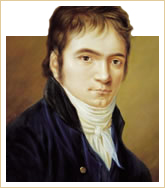
On his father’s side, Beethoven came from a musical lineage—in the 18th Century it was customary for children to follow in their parent's footsteps. His grandfather—Ludovicus van Beethoven, born Lodewijk van Beethoven (1712-73)—had been the musical director (Kapellmeister) of the Elector's Chapel, and as a separate occupation maintained a wine trade business. His father, Johann van Beethoven (c. 1740–92), was a singer in the Chapel choir by 1762 (age 22), and to supplement his small income gave voice and piano lessons to the nobility and rich families in Bonn. In 1767, Johann married Maria Magdalena Keverich (1746-87), a young widow from Trier, a town a short distance up the Rhine from Bonn.
From early on in the marriage, Beethoven's mother resigned herself to an unhappy relationship in the face of Johann's unfulfilled musical ambitions and quick descent into alcoholism—as his mother before him, Johann was a heavy drinker, and to make matters worse, was also an abusive father who often beat Ludwig. In the face of such adversity (to a friend she described marriage as 'a chain of sorrows'), Beethoven's mother became a source of strength and comfort for her family until her death of consumption on 17 July 1787, at age 40. Beethoven wrote after her death that 'she was [such] a kind, loving mother to me, and my best friend'.
By the age of five, Beethoven already showed remarkable musical talent. Probably with the image of Leopold Mozart and his genius son Wolfgang in mind, Johann decided to teach his son the rudiments of piano and violin playing. Beethoven, however, did not pay much attention to his father's teaching methods, preferring to spend time alone improvising at the keyboard. Nonetheless, on 26 March 1778, his father presented him in Cologne, in a concert of his more advanced pupils. The archbishop-prince of Bonn became interested in the child and decided to further his music education.
In 1781, Christian Gottlob Neefe became Beethoven's teacher after the death of Heinrich van den Eeden, who had been put in charge of the child's musical education by the archbishop prince. Influenced by the ideals of the Enlightenment, and by Leopold Mozart's teaching methods, Neefe exposed Beethoven to the finest composers including J. S. Bach, Johann Christian Bach, Carl Phillip Emanuel Bach, and the contemporary Joseph Haydn. In fact, J. S. Bach's Well-Tempered Clavier became Beethoven's material for learning counterpoint. From Neefe, Beethoven also learned the values of the Enlightenment, that would influence so much of his later music.
In 1787, Maximilian Franz the archbishop-prince, brother of the Emperor Joseph II, decided to send Beethoven to Vienna for further lessons with Mozart, but only two weeks after arriving there in 1787, his mother fell gravely ill, and he had to return to Bonn. Maria Magdalena died shortly after on July 17. A few months later, in 1789, at age 19, Beethoven obtained a legal order by which half of his father's salary was paid directly to him, and became the official head of the family
During 1789 and 1790, the operas of Europe's most famous composers were performed in Bonn. These include works by André Grétry, Antonio Salieri, and Georg Anton Benda, plus Mozart's The Abduction from the Seraglio, The Marriage of Figaro, and Don Giovanni.
Beethoven was probably first introduced to Joseph Haydn in late 1790, when the latter was travelling to London and stopped in Bonn around Christmas time. A year and a half later, they met in Bonn on Haydn's return trip from London to Vienna in July 1792. In November of that year, with the Elector's help, Beethoven left Bonn for Vienna to study with Haydn. Shortly after his arrival, he learned that his father, Johann, had finally succumbed to alcoholism. Thus, Beethoven became the family's breadwinner at age 22. This time, however, he remained in Vienna to establish a music career.
Understanding Beethoven as a man is crucial to understanding Beethoven as an artist. He was, by all accounts, prone to extremes of emotional bouts of melancholy or sadness followed by the utmost elation. He never married and was not easy to get along with. Baron Ignaz von Gleichenstein wrote to Beethoven in 1810 or 1811: "Again and again your friendship causes me fresh irritation and pain."
Beethoven’s music is commonly divided into three periods: the Early Period (before 1802), the Heroic Period (1803-1815), and the Late Period (1816-1827). Although there's no definitive consensus about those specific dates, the divisions are based on the stylistic differences in the music of each period and on the personal experiences that surrounded them.

Beethoven’s music is commonly divided into three periods, the Early Period (before 1802), the Heroic Period (1803-1815), and the Late Period (1816-1827)...

The Early Period
As is usually the case with a young composer, Beethoven’s early works reveal a musician trying to find his own voice. In this period more than any other, his music closely resembles the Classical traditions of W.A. Mozart (1735-91), and Franz Joseph Haydn (1732-1809). As noted above, Haydn became Beethoven's tutor soon after Beethoven's arrival in Vienna in 1792, when Haydn came back to that city from his first trip to England—the two had briefly met in Bonn on December 1790 at the beginning of that trip and Haydn had been sufficiently impressed to tell Beethoven that if he could arrange to come to Vienna, he would gladly take him on as a pupil. Their relationship seems to have been affected by the fact that Haydn, who at the time was probably the most celebrated composer in Europe, was extremely busy with his own compositions and commissions. In fact, during this time Beethoven took lessons with other teachers—vocal music with Salieri from 1800 to 1802, and violin under Ignaz Schuppanzigh—often in secret so as not to offend Haydn. Beethoven's apprenticeship period with Haydn ended around 1794, when Haydn left for a trip to England, and although there was no falling-out between the two, Beethoven is known to have said, "I never learned anything from Haydn."
Beethoven’s early piano writing was also influenced by the Italian-born English composer, pianist, pedagogue, conductor, music publisher, editor, and piano manufacturer Muzio Clementi (1752-1832), whose keyboard sonatas and sonatinas, such as the Progressive Sonatina Op. 36 No. 6 in D Major, also served as models for later important musicians including John Field, Johann Baptist Cramer, Ignaz Moscheles, Giacomo Meyerbeer, Friedrich Kalkbrenner, Johann Nepomuk Hummel, and Carl Czerny. According to Beethoven's associate, secretary, and early biographer, Anton Schindler (1795-1864), Beethoven often played Clementi sonatas and recommended them to many people. Schindler wrote: "He (Beethoven) had the greatest admiration for these sonatas, considering them the most beautiful, the most pianistic of works, both for their lovely, pleasing, original melodies and for the consistent, easily followed form of each movement."
Composer: Muzio Clementi
-
"Progressive Sonatina, Op. 36: No. 6 in D Major"
Beethoven’s early fame in Vienna came as a pianist, so it is not surprising that his first important compositions are for piano. The early sonatas include the Pathétique Sonata, Op. 13 in C Minor, one of his most dramatic early works. The first movement begins with an introduction marked Grave, followed by a powerful first theme that seems to rocket from nowhere. Later, in the second movement, Beethoven presents a beautiful melody in a simple classical rondo form. But when the theme returns in the final section, its rhythmic structure is altered from a simple division to a triplet or compound division. Beethoven found important symbolism in the process of developing a particular theme throughout a composition. To him, the progression of the theme mirrored the transformation of life through trials. In the Pathétique, this transformation is represented by the departure from the main theme in the B and, most importantly, C sections.
Composer: Ludwig van Beethoven
-
"Piano Sonata No. 8 in C minor, Op. 13, Pathétique: I. Grave"
"Pathétique Sonata Op. 13 (II movement)"Ludwig van Beethoven (1770-1827)
Composer: Ludwig van Beethoven
-
"Piano Sonata No. 8 in C Minor, Op. 13, "Pathetique": II. Adagio cantabile"
Composer: Ludwig van Beethoven
-
"Piano Sonata No. 8 in C Minor, Op. 13, "Pathetique": II. Adagio cantabile" [ 00:00-01:02 ]01:01
Composer: Ludwig van Beethoven
-
"Piano Sonata No. 8 in C Minor, Op. 13, "Pathetique": II. Adagio cantabile" [ 01:04-01:50 ]00:47
Composer: Ludwig van Beethoven
-
"Piano Sonata No. 8 in C Minor, Op. 13, "Pathetique": II. Adagio cantabile" [ 01:49-02:20 ]00:30
Composer: Ludwig van Beethoven
-
"Piano Sonata No. 8 in C Minor, Op. 13, "Pathetique": II. Adagio cantabile" [ 02:20-03:09 ]00:48
Composer: Ludwig van Beethoven
-
"Piano Sonata No. 8 in C Minor, Op. 13, "Pathetique": II. Adagio cantabile" [ 03:08-04:48 ]01:41
The first two symphonies and first three piano concertos also belong to the early period. His Symphony No. 1 in C Major is a monument to Classical symphonic style. In every way, it is a typical Classical symphony, complete with a slow introduction to the first movement and a raucous rondo conclusion. In an auspicious beginning to what will become a steady departure from Classical style, Beethoven opens the symphony on a secondary dominant chord, effectively moving us away from the tonic before we have even heard it.
Composer: Ludwig van Beethoven
-
"Symphony No. 1 in C Major"



