Learning Objectives
- Describe the role of keyboard instruments as an orchestral, solo, or accompanying instrument.
- Compare and contrast the different types of keyboard instruments, including the piano, harpsichord, organ, and synthesizer.
- Define the following musical terms and instrument types: concerto, electrophone, keyboard instruments, recital, repertoire, solo, and soundboard.instruments, recital, repertoire, solo, and soundboard.
The Harpsichord
Introduction
On the harpsichord, tones are produced by strings stretched over a soundboard, which is a thin piece of wood that amplifies the sound of the strings.

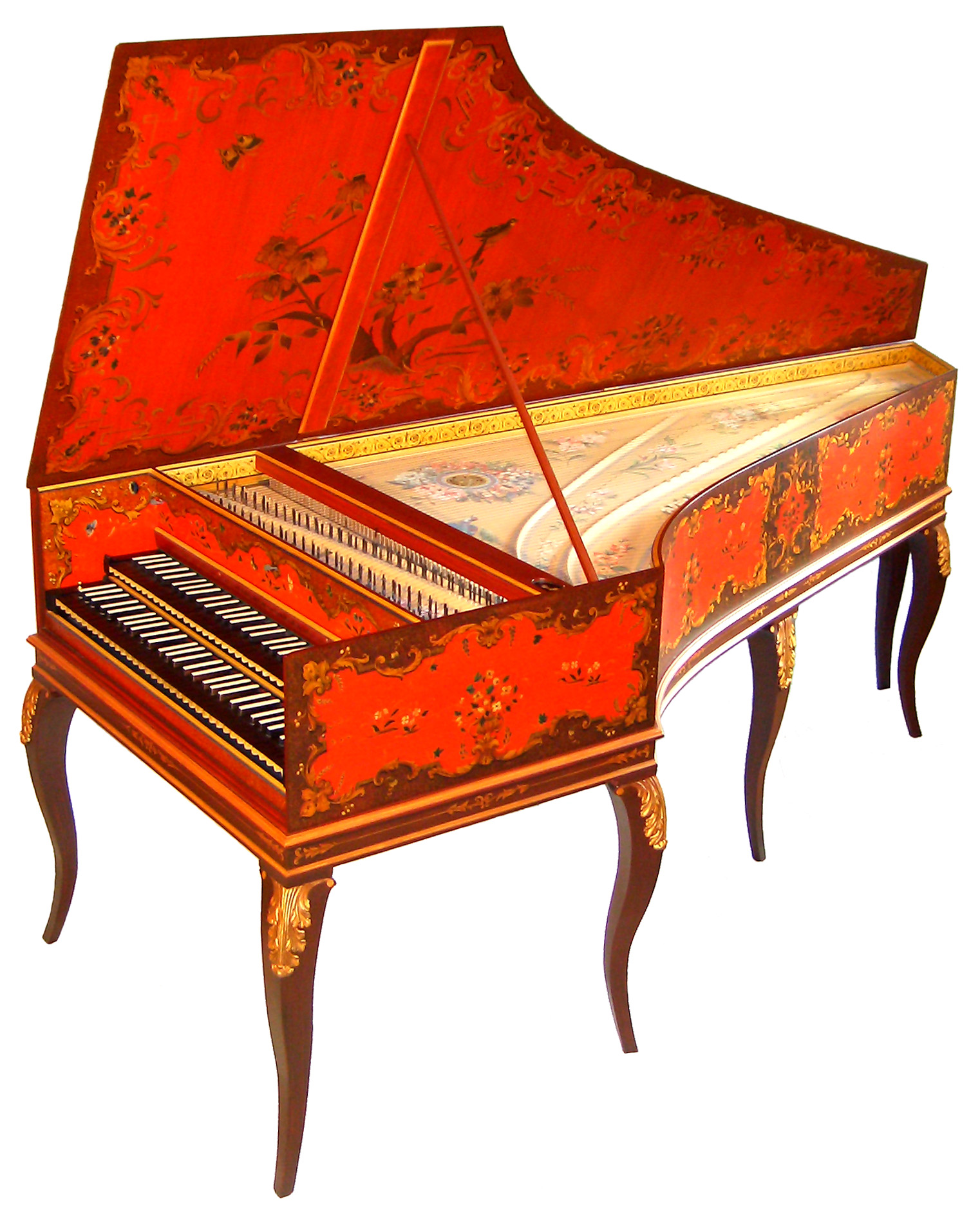
When the harpsichordist depresses a key, a simple mechanism causes a plectrum (or quill) to pluck a string. Harpsichords are not necessarily built to the same specifications. Sometimes they have more than one string per key, which means that more than one string may be used to produce a sound.
The harpsichord keyboard is not touch-sensitive. This means that no matter how softly or forcefully one presses a key, the sound the instrument produces will maintain a fairly constant volume level. Well-built harpsichords are capable of producing quite a rich sound.
The first known instance of a harpsichord dates from around 1397. The harpsichord was very important during the 16th, 17th, and early 18th centuries as both a solo and an accompanying instrument. It was used in chamber and orchestral music and also in opera. When the fortepiano was invented around 1709, it eclipsed the popularity of the harpsichord for the next 200 years. However, contemporary musicians and music lovers have a new appreciation for the sound of the harpsichord and the music written for this beautiful instrument.
Composer: George Frideric Handel
-
"Keyboard Suite No. 1 (Set I) in A Major, HWV 426: III. Courante"
Composer: François Couperin
-
"Les Barricades Misterieuses"
Composer: Johann Sebastian Bach
-
"Brandenburg Concerto No. 5 in D Major, BWV 1050: I. Allegro"