




Pitch Bending
At the heart of the blue note is pitch bendingA gradual change in pitch from one note to another.. Listen to Robert Johnson's classic guitar pitch bending in his rendition of Cross Road Blues ♫. In fact, practically speaking, you can't have a blue note without pitch bending.
Pitch bending is a gradual change of pitch, and it is one of the most distinctive ways in which blues singers sing their melodies. Certain instrumentalists may also incorporate pitch bending in performance. For example, you may have heard a trombonist slide between notes or a guitar player slightly raise or lower a note.
It's not surprising, then, that some of the earliest blues singers accompanied themselves on the guitar, developing various techniques for bending the pitches of the strings. These include bending the guitar strings with the fingers on the fret board, as well as using a bottleneck on the pinky to slide over the strings.
In Gus Gibson's "Railroad Song," we can hear individual strings being bent, as well as the guitarist's use of a slide. When Gibson begins to sing, the third note of the scale is a prominent blue note in his melody. Let's listen Railroad Song ♫.
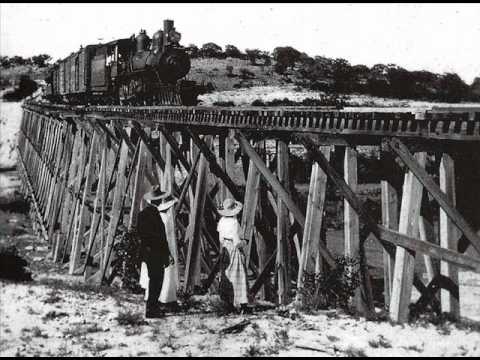
Gus Gibson - Railroad Song
Harmony
The sounding of two or more pitches together creates harmonyThe sounding of two or more pitches together.. For example, harmony is created when an instrument, such as a guitar or piano, is played along with (i.e., accompanies) a singer. Guitar and piano are both instruments capable of sounding more than one pitch at a time — producing harmony without the need for further accompaniment. Not surprisingly, they have remained important instruments in both blues and jazz.
Let's listen to an example of blues harmony in Robert Johnson's I Believe I'll Dust My Broom ♫. As we explore the characteristics of harmony, and specifically of blues harmony, we will gain a better understanding of the harmonies we hear in this blues piece. For now, let's focus on the high notes of Robert Johnson's guitar (0:05-0:06, 0:09-0:11, and 0:19-0:21). The two prominent notes we hear sound the interval of a thirdAn interval of three letter-name notes..
Harmony in Western music is based on the interval of a third. An intervalThe distance between two pitches in terms of letter-name notes. is the distance between two notes. Take, for example, the interval C to E: that's a third. We call it a third because we count the notes of the scale in the interval, C-D-E, one-two-three. Similarly, F to A (F-G-A) is a third.
Click the speaker icon to hear an interval of a third.
The melodic interval C-E
Click "Show Me" to see how that interval was figured.
Interval of a Third
Calculating the interval size from C to E



