Learning Objectives
- Examine how the treble and bass staves can be joined to form the grand staff.
- Investigate the role of middle C as a important reference point.
- Learn how the 8va (ottava) sign works.
Clefs V: The Grand Staff
The Grand Staff
The music for most instruments is written using only one staff. In keyboard or choral music, however, where the range of pitches covered can be quite wide, the treble and bass staves may be joined to form the great or grand staff. Word of caution: The grand staff is sometimes mistakenly called the "double staff." The correct technical term is grand staff. Also, note that the plural of staff is staves, not staffs.
As the example below illustrates, the two staves in the grand staff are joined by a bar and a bracket. In keyboard music, notes written in the treble clef of the grand staff are typically played by the right hand and the ones in the bass clef are played by the left hand.
The Grand Staff
| The grand staff |
Middle C
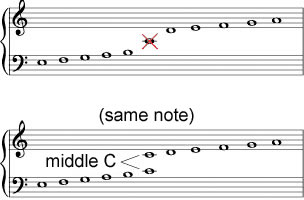
Located halfway in between the two staves of the grand staff is middle C (C4). This is an important reference point in the continuum between the treble and bass staves. It should be noted, however, that this pitch should not be written in the middle of the space between the staves (as shown in the first example below). Notes with ledger lines should extend from one of the existing staves. So, middle C can be written either as an upper extension to the bass staff or a lower extension to the treble staff (using just one ledger line in either case, as shown in the second example below). This middle pitch is the same note in both clefs: C4, representing the point at which the two staves meet.
Ledger Lines and the Grand Staff
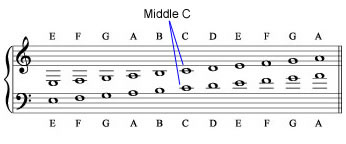
Additional ledger lines can also be used between the treble and bass staves of the grand staff, as illustrated below. Notes above middle C can be written in the bass staff by adding ledger lines above the staff. Similarly, notes below middle C can be written in the treble staff by adding ledger lines below the staff. In keyboard music, notes with ledger lines might be chosen rather than notes on the other staff in order to keep the notes for the left and right hands in separate staves.
Of course, ledger lines can also be positioned above and below the two staves of the grand staff, as illustrated in the example below. Can you identify the names of these notes?
| Ledger lines above and below the grand staff |
Frederic Chopin: Prelude in C Minor (excerpt)
Prelude in C minor, Op. 28, no. 20 by Frederic Chopin (1810-1849) illustrates the use of the grand staff, with many ledger line extensions. Notice however, that the right hand in the upper staff sometimes moves so low that a temporary clef change is required, such that there are actually two bass clefs (see the first line, for example). Similarly, both hands could move into the higher range of the keyboard, requiring two treble clefs. This is not uncommon in keyboard music.
Ottava Sign
The 8va sign, which means ottava, is sometimes placed above a group of notes in the treble clef to indicate that those notes should be played an octave higher than written. It is used to avoid having to read excessive ledger lines above the treble clef for parts that are very high. For example, the two passages below would sound the same, with the first being played an octave higher than written.

Ludwig van Beethoven: Symphony No. 5 in C Minor (excerpt)
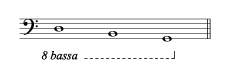
The 8va bassa sign (sometimes written 8vb) is typically placed below a group of notes in the bass clef to indicate that those notes should be played an octave lower that written. For example: