
Overview
In the 1920s, a new type of jazz emerged that was related to, but separate from, Dixieland. Called swing or big band, this music often had less improvisation, more dancing, and more instruments than its Dixieland counterpart. Led by bandleaders such as Duke Ellington, Benny Goodman, and Fletcher Henderson, swing bands provided the soundtrack for dancing and merrymaking during what were becoming increasingly difficult times in the United States.
Objectives
- Recognize the difference between swing music and Dixieland jazz such as instrumentation, form, purpose, and composition
- Examine how race relations affected the performance and recording of swing music throughout the 1930s and 1940s
- Identify various bandleaders and the way each cultivated a specific style within their individual groups such as Count Basie’s Kansas City swing style
Kansas City Swing
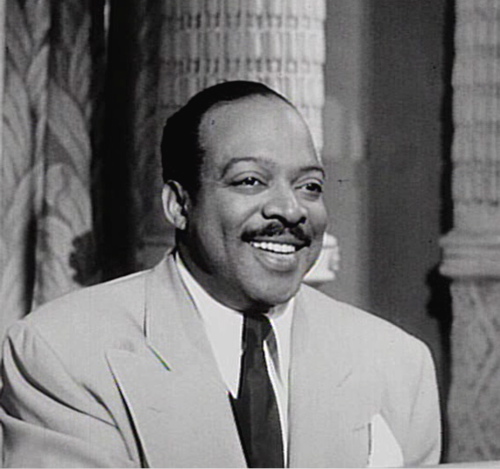
William "Count" Basie was from Redbank, New Jersey, and, touring as pianist with a show, got stranded in Kansas City in 1927. He played piano in a movie-theater pit, then in Walter Page’s Blue Devils, and finally in Bennie Moten’s band. When Moten died in 1935, Basie formed a band of his own consisting largely of Moten alumni. Kansas City was an ideal location for a burgeoning jazz scene, with its crooked mayor and lively nightlife. One night in Chicago in 1936, John Hammond was going up and down the AM radio dial when he picked up the faint sounds of the Basie band over Station WXBY from Kansas City’s Club Reno on his shortwave radio.
He asked his friend Benny Goodman to travel to Kansas City to hear the band in live performance. Hammond arranged for bookings in Chicago and New York, a national tour, and recording contracts, and before long, the Basie band was one of the country’s favorite jazz ensembles, much in demand in dance halls, theaters, colleges, and hotels. A booking into the Famous Door, a tiny jazz club in New York from 1938 to 1939, with almost nightly national network radio broadcasts, made Count Basie one of the most popular bandleaders in the United States.
The big band style of Basie was unique among the swing bands of the 1930s, largely due to its rhythm section: Basie on piano, Walter Page on bass, Freddie Green on guitar, and Jo Jones on drums. Page developed the walking basswhen the bass moves up and down the scale, playing a note on each beat style, in which the bass player delivers an ascending or descending stepwise pattern of notes. In a walking bass line, each note falls directly on the beat without any syncopation. Jones focused his drumming on the hi-hata pair of foot-operated cymbals, saving the bass drum for accents. Basie was the first jazz pianist to compthe interjection of sparse chords and motives between and among the phrases of the horns, either solo or in ensemble. Comping is the interjection of chords by the pianist between the phrases of the horns.
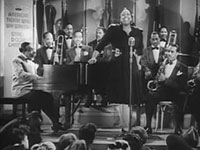
Further, Basie integrated stylistic elements from boogie-woogie into his playing, such as the repeated ostinato in the left hand. The style Basie and his band codified is known as the Kansas City style. This style of playing can be heard in recordings such as "Straight Ahead ♫" and "Lester Leaps In ♫."



