
Overview
Objectives
- Identify two important figures in early American folk music, Pete Seeger and Woody Guthrie
- Recall why Pete Seeger and Woody Guthrie were inspirational figures in the folk revival of the 1960s
- Examine the music and career of Bob Dylan
- Recall why Bob Dylan's electric performance at the 1965 Newport Folk Festival was so upsetting to folk music purists
- Recall the many stylistic and generic reactions to Dylan "plugging in," namely, the rise of the genre of folk rock
Bob Dylan continued
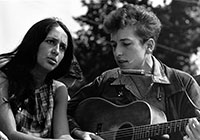
Dylan’s performance at the 1965 Newport Folk Festival is the stuff of legend. Some claim that the audience booed Dylan off the stage. Al Kooper, the organ player in the Paul Butterfield Blues Band, recalled that people were booing because of the poor sound quality, not because Dylan was playing an electric guitar. Others recall that the audience was not booing but was in fact yelling, "More!" One legend has it that an infuriated Pete Seeger stormed the stage with an axe in order to cut the power supply to Dylan’s guitar. Perhaps none of these stories are true, or perhaps all of them are.
Regardless, the controversy Dylan generated when he went electric cannot be overstated. Folk music purists saw him as a sellout who was now worshipping at the altar of commercial music. They believed that Dylan had given up his folk roots in order to sell more records and become more viable commercially. Rock fans may have loved Dylan’s sound, but his lyrics were far more intense in topic and delivery style than other rock music that was popular at the time. Despite the strong opinions on both sides, everyone agreed that Dylan had taken a step that could not be undone. For the most part, his transition to rock-inspired folk music was well received.
Despite the fact that Dylan had "gone electric," he had otherwise not abandoned his folk roots. He continued to write songs about social issues, although they were often broadly interpreted and had many potential meanings. Further, many of Dylan’s so-called "love songs" are wry assessments of relationships, filled with ironic statements and blunt observations about the nature of human behavior.
"Like a Rolling Stone ♫" includes an organ and a piano in addition to the standard electric guitar, bass, and drums of a rock band. Dylan’s vocal style is somewhere between speech and song, and his aggressive delivery leaves little to the imagination about the opinions he is communicating in the song. "Like a Rolling Stone" addresses a woman who has somehow lost her wealth, although we never learn how or why she lost it. In the song, Dylan chastises the woman for putting too much value on money and material possessions. As in "Blowin’ in the Wind," "Like a Rolling Stone" asks a series of rhetorical questions. "Like a Rolling Stone" is in verse-chorus form, but the verses are much longer than in popular songs of the day. In fact, the song is over six minutes long, which made it the longest 45 RPM single that had ever been released at the time.



Woody Guthrie became part of the mass migration of dust bowl refugees known as "Okies." Without food or money, Woody hitchhiked, rode freight trains, and even walked to California, developing a love for traveling on the open road -- a practice he would repeat often.
