
Overview
Objectives
- Recall the major developments of jazz after swing, including bebop, cool jazz, and fusion
- Recognize Miles Davis and his contribution to the major movements in jazz
- Examine the musical language and controversy of Bitches Brew
- Identify several musicians who formed successful fusion groups during the 1970s and the defining features of their musical styles
Fusion in the 1970s
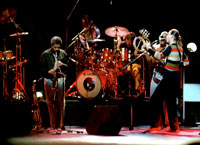
The most popular and influential of the post-Bitches Brew fusion ensembles was Weather Report, formed by Austrian keyboardist Joe Zawinul and African American saxophonist Wayne Shorter in 1971. They added Miroslav Vitouŝ, a classically-trained Czech bass player, Alphonse Mouzon, an African American drummer, and Airto Moreira, a Brazilian percussionist who had also played on Bitches Brew. The group’s early recordings were filled with avant-garde experimentalism, such as free forms and continually unfolding solo lines.
For example, "Milky Way ♫," from 1971’s Weather Report, was created by Shorter playing his muted saxophone into the strings of Zawinul’s piano, creating an ethereal, atmospheric recording. Zawinul was constantly exploring new methods of sound creation and production, including ring modulators, unusual percussion instruments, tape delay effects, the ocarina (an enclosed vessel flute with finger holes), the African thumb piano, the melodica (an instrument that is half harmonica, half keyboard), and the Oberheim Polyphonic synthesizer. The group frequently invited guest musicians to perform with them, both live and in their recordings.
By 1973, Weather Report was no longer playing free-form, avant-garde music. Instead, they began performing music that was heavily influenced by rock, funk, and rhythm and blues. The songs had clear forms adapted from rock music, and electric keyboards gained prominence. They frequently used synthesizers. This rock-inspired style of playing was problematic for Vitouŝ, an acoustic bass player with classical training. He was soon replaced with Alphonso Johnson, an electric bass player whose style was better suited to the rock and funk direction the band was taking. Weather Report also began using a single consistent rhythm section, rather than constantly substituting and exchanging drummers, percussionists, and bassists.
In 1976, Johnson was replaced with Jaco Pastorius, a fretless bass player who had a melodic playing style. Weather Report’s first album with Pastorius was 1977’s Heavy Weather, which was also their best-selling album. The standout single from Heavy Weather was "Birdland ♫," which was composed by Zawinul. "Birdland ♫" features singing bass lines from Pastorius that sound more like melodies than bass lines. The track also prominently features a synthesizer that creates the sound of a brass ensemble.

The name of the track comes from a prominent New York jazz club, and the club received its name because jazz legend Charlie Parker (nicknamed "Bird") frequently played there. Despite the track’s strong influences from rock, such as the electric bass line, the synthesizers, and the straight rhythms, it is clearly indebted to jazz both in its name and in the instrumental performance style from musicians such as Shorter.
Weather Report continued to tour and record until 1986, but the membership was constantly shifting. When the band dissolved in 1986, Zawinul and Shorter were the only remaining original members. Zawinul continued to play until his death from cancer in 2007, and Shorter still performs live and records.



"In 2007, Herbie Hancock released his 47th studio album entitled River: The Joni Letters. The album was meant as a tribute and homage to longtime friend and fellow musician Joni Mitchell. Guest vocalists on the album included Leonard Cohen, Tina Turner, Norah Jones, Corinne Bailey Rae, Luciana Souza, and Mitchell herself. In February 2008, the disc beat out Amy Winehouse, Foo Fighters, Vince Gill, and Kanye West to win the Album of the Year award at the 50th annual Grammy Awards in Los Angeles. It was the first jazz album to win the award in over four decades and only the second in the award's history."
